
Intelligente Contract Solutions: Anwendungsfälle, Funktionalitäten und wie man sie bewertet (2026)
Table of contents
Intelligente Contract Solutions sind Systeme, die Verträge von statischen Dokumenten in...
Intelligent contract solutions are systems that turn contracts from static documents into operational decision logic—by extracting meaning from contract language, applying standards (policies/playbooks), and triggering workflows (approve, escalate, redline, track obligations, report). The difference between “smart” and truly “intelligent” is governed decision-making: consistent outcomes you can explain, measure, and audit.
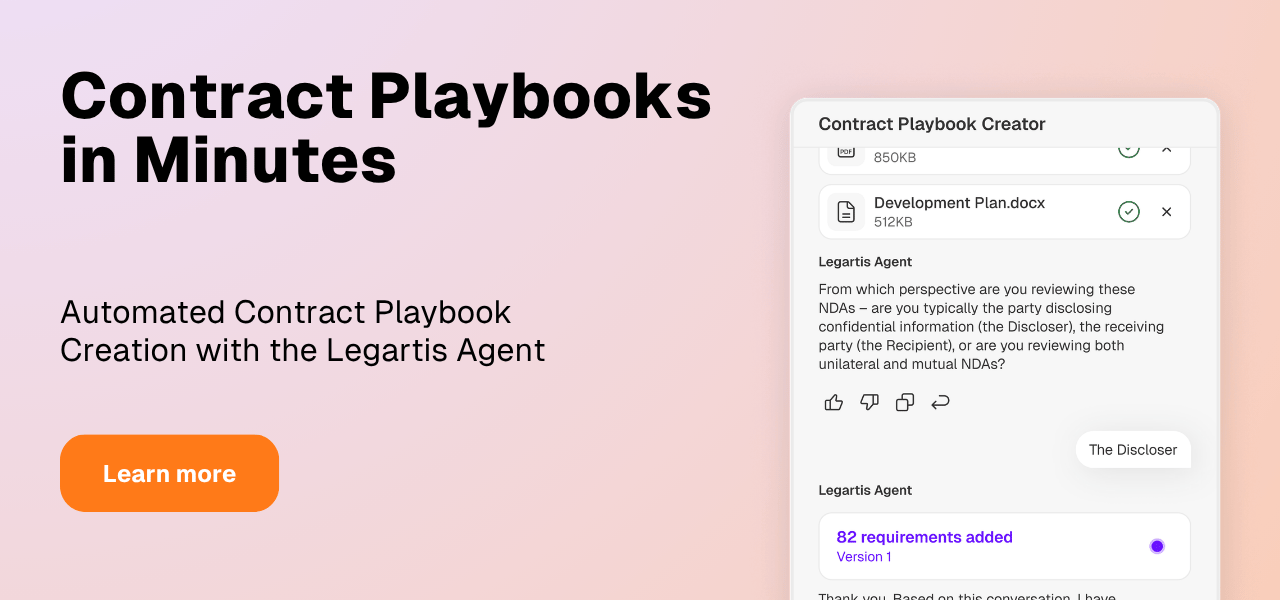
A practical example of a playbook-first approach is the Legartis Contract Playbook Creator, which focuses on converting contract standards into structured playbook logic and validating quality iteratively with transparent signals.
Before we go deeper, here’s how to read this article: we’ll first clarify what the market means by “intelligent contract solutions,” then show how real-world buyers evaluate these systems (capabilities, governance, ROI), and finally give you a concrete checklist you can use in a pilot. The goal is not to list “AI features,” but to make the decision criteria explicit.
Table of contents
1. What “intelligent contract solutions” means (and what it doesn’t)
A term used for three different solution types
In many organizations, “intelligent contract solutions” is used as an umbrella term, even though it can describe very different tool categories. Clarifying which category you mean upfront avoids mismatched expectations later—especially in pilots.
In practice, “intelligent contract solutions” tend to mean one of these:
When someone says “we need intelligent contract solutions,” the fastest way to narrow the field is to ask what the system should do first—manage the lifecycle, extract and analyze contract data, or enforce standards and decisions in review. The answer determines what “good” looks like.
What it is not
This distinction matters because some adjacent concepts are frequently mixed into the discussion, and that can derail tool selection.
Now that the boundaries are clear, the next question becomes impact: which outcomes should the solution improve first, and for whom? Even if Legal sponsors the initiative, measurable benefits usually show up as changes in throughput, risk control, and predictability across multiple teams.
2. Intelligent Contract Solutions for Different Teams
Finance
The Finance perspective forces clarity on measurable contract impact: where contracts affect revenue timing, audit exposure, and financial risk—not just legal correctness.
Typical pain: revenue recognition delays, contract risk exposure, audit pressure.
What “intelligent” means: contract scoring, structured extraction of revenue/termination terms, consistent risk tagging, audit-ready evidence trails.
RevOps
RevOps typically experiences contracting as pipeline friction. This angle emphasizes bottlenecks, handoffs, and visibility into exceptions so that deal progress becomes more predictable.
Typical pain: deals stuck in legal review, poor visibility into exceptions, pipeline friction.
What “intelligent” means: exception routing, standard fallback positions, turn-around-time analytics, cross-team alignment.
Marketing
Marketing enters the picture in enterprise buying when trust and standardization reduce friction: consistent terms, compliance signals, and smoother procurement/security reviews.
Typical pain: proving trust, consistency of claims, reducing friction in enterprise buyer reviews.
What “intelligent” means: certification/trust signals, consistent terms, faster procurement/InfoSec alignment.
Legal
Legal is often the anchor: the challenge is not only volume, but also consistency across reviewers and the ability to explain and defend decisions when exceptions occur.
Typical pain: growing volume, repeated low-risk reviews, inconsistent decisions across reviewers.
What “intelligent” means: playbook enforcement, deviation detection, escalation rules, measurable QA, audit trails.
Procurement
Procurement adds a scale lens: vendor terms diverge in many small ways that add up to risk and cost. Intelligence here means fast, consistent deviation detection and structured follow-up.
Typical pain: vendor term deviations at scale, hidden liability, slow approvals.
What “intelligent” means: benchmark vendor terms, highlight deviations, route exceptions, track obligations/renewals.
Across all teams, the key is to translate outcomes into capabilities you can test. The next section is a compact capability model you can use to separate “AI features” from systems that reliably drive governed decisions.
3. Core Capabilities: What Separates “intelligent” from “basic”
Most vendors can demo impressive outputs on curated examples. The question is whether those outputs remain consistent across real documents, real deviations, and real edge cases. Use this as a quick maturity model. If a vendor can’t demonstrate these in a pilot, “intelligent” is usually marketing.
CapabilityWhat “good” looks likeWhy it matters1. IngestionPDF/Word/email intake + metadata captureRemoves manual prep2. Clause & data extractionHigh precision + traceability to textReduces silent errors3. Contextual risk detectionNot keyword-only; understands meaningCuts missed issues4. Playbook enforcementRules tied to policy and fallback logicEnsures consistency5. Suggested redlinesEdits aligned to playbook positionsSpeeds negotiation6. Workflow automationApprovals, routing, escalations, SLAsRemoves bottlenecks7. Obligation managementTrack duties, dates, renewalsPrevents leakage8. AnalyticsCycle time, deviations, clause KPIsEnables governance9. Security & complianceSSO, access controls, residency optionsEnables adoption10. Quality controlsTest sets, scoring, audit trailsPrevents false confidence
Interpretation tip: capabilities 1–9 determine whether the tool is useful. Capability 10 determines whether the tool is safe to trust at scale. That’s why the next section focuses on playbooks and the “intelligence layer”—the point where understanding becomes enforceable decisions.
4. Playbook Automation: from Standards to Decisions (the “intelligence layer”)
The core idea is that contracts only become operational when standards are explicit and enforceable. Playbooks are how organizations encode those standards so they can be applied consistently—across reviewers, regions, and contract types.
A contract playbook is your organization’s internal rulebook: preferred clauses, fallback positions, escalation paths, and “deal breakers.” Legartis Contract Playbook Creator highlights how agentic playbook creation can analyze existing contracts to standardize clauses and suggest fallback positions, and then weave escalation logic into authoring.
Why playbooks decide whether AI helps or hurts
Many disappointments with contract AI come from “intelligent reading” without “standardized deciding.” If standards remain implicit, AI output can look polished while still producing inconsistent decisions.
Without a playbook (or equivalent explicit standards), AI tends to produce:
“Intelligent playbooks” as an emerging pattern
To address this, vendors increasingly position “intelligent playbooks” as the bridge between standards and execution: playbooks become usable outside Legal through guided reviews and scalable enforcement. This is also where the category begins to affect multiple functions, because consistent decisions can be embedded into workflows.
Intelligent Contract SolutionsLifecycle + decision layerContract lifecycleDraft↓Review↓Negotiate↓Sign↓ManageIntelligence layer• Extract clauses & obligations• Apply playbook rules (preferred + fallback)• Trigger workflows (approve / escalate / redline)• Quality controls (tests, scoring, audit trail)• Analytics (cycle time, deviations, KPIs)• Security & governance (roles, residency, retention)
Where Legartis fits (decision-layer, playbook-first)
A playbook-first approach is designed to convert standards into enforceable review outcomes rather than leaving the decision step to ad-hoc human interpretation after an AI summary.
Agentic Legal AI solutions such as the Legartis Contract Playbook Creator explicitly focus on operationalizing legal standards into a system of requirements, fallbacks, and escalation logic—so reviews can be scaled consistently.
And AI for Contract Review by Legartis explains how playbooks guide review outcomes (approve / escalate / redline) for legal, sales, and procurement teams.
Once playbooks become the decision layer, trust becomes the limiting factor. If the system is confidently wrong, automation doesn’t reduce risk—it scales it. The next section captures the minimum governance controls required to keep “intelligence” from turning into liability.
Must-have controls (non-negotiable)
A concrete example of this “governed” direction is described in Legartis launches the “Contract Playbook Creator”, where automated playbook creation is paired with iterative verification using test sets and a transparent quality score.
6. ROI Drivers: where Savings and Risk Reduction Actually Come From
Avoid vague ROI claims. Tie outcomes to measurable deltas:
A practical way to sanity-check ROI is to ask where time is actually saved. If the process still requires extensive manual verification, you’ve shifted work—not removed it. That’s why the underlying decision flow matters: standard cases are fast-tracked, while deviations are escalated or redlined based on thresholds.
Playbook automation is explicitly marketed as a way to accelerate review and cut workload in offerings like Legartis AI for contract review or legal analytics.
From a CLM angle, JAGGAER frames AI and automation as streamlining workflows and enhancing compliance—typical enterprise ROI language for CLM-led buyers.
Playbook-driven contract reviewDecision flow1) Ingest contract(PDF / Word)↓2) Extract clauses+ context↓3) Match againstplaybook rules↓DecisionOK → approve / fast-trackNo material deviations detected↓Deviation → redline / escalateRoute to owner based on thresholds Note: “Intelligent” requires quality controls (confidence thresholds, test sets, audit trail).
Now that the decision logic and ROI levers are clear, vendor evaluation becomes much simpler. The next section is a copy/paste toolkit you can use to qualify vendors quickly and structure a pilot.
7. Buyer’s Checklist + Evaluation Scorecard
Quick pre-qualification (10 questions)
Evaluation scorecard (weights you can adapt)
CategoryWeightWhat to look forPlaybook enforcement20%Automated deviation checks, routing, redlines (legartis.ai)Quality controls20%Test sets, scoring, auditability (legartis.ai)Accuracy & coverage15%Contract types, languages, formats (legartis.ai)Workflow fit15%Word-first, CLM-first, email intake (legartis.ai)Security & compliance15%SSO, encryption, residency options (legartis.ai)Analytics10%Deviations, cycle time, KPIs (legartis.ai)Total cost5%Licensing + implementation (legartis.ai)
Pilot success metrics (use this in your kickoff)
Selection is only half the work; the other half is rollout discipline. The next section outlines a practical 90-day path that reduces risk by starting narrow, validating quality, and then expanding.
8. Implementation Blueprint (a realistic 90-day path)
Days 1–14: Scope + standards
Days 15–45: Pilot + QA
Days 46–90: Workflow + rollout
-----
Do you want to see what governed contract intelligence looks like in practice—playbook enforcement, measurable quality controls, and an audit trail? Book a demo with Legartis and we’ll walk through real examples against your standards.
------
9. Frequently Asked Questions
What are intelligent contract solutions?
They combine contract understanding (extraction, classification, risk detection) with governance (playbooks/policies) and automation (routing, approvals, redlining, obligation tracking) to scale consistent decisions across teams.
How is this different from CLM?
CLM manages the lifecycle (drafting, negotiation, signing, storage). Intelligent contract solutions emphasize decision intelligence: enforcing standards and extracting actionable insights that drive workflows and governance.
Do we need a contract playbook first?
You need standards in some form. A playbook makes decisions explicit (preferred, fallback, escalation), which is what automation needs to be consistent and auditable.
What's the biggest risk?
False confidence: fluent outputs that miss nuance. Mitigate with test sets, confidence thresholds, audit trails, and strict escalation rules for uncertainty.
What should we measure in a pilot?
Cycle time, escalation precision, deviation detection quality, reviewer time saved, and obligation capture completeness.
Explore Related Insights
More articles related to this topic

Intelligent Contract Management: How Inhouse Teams Manage Contracts Predictably

How to Create a Contract Playbook in 5 Steps

Contract Reviews with ChatGPT? Chances, Risks, Alternatives
Start withLegartis Today!
Talk to us about your business case or test Legartis right away!