
Contract Reviews with ChatGPT? Chances, Risks, Alternatives
Table of contents
ChatGPT for contract review?
A contract is uploaded or pasted into the interface. ChatGPT is asked to highlight risks, explain clauses or provide recommendations.
The motivation behind this is understandable:
- less manual effort
- a quick initial assessment
- no waiting for internal or external legal teams
- easy to use, no setup required
The practical appeal is clear, but the legal reliability is not—especially given that large language models still hallucinate and remain opaque regarding the sources of their answers.
This raises a central question:
Can a generative language model like ChatGPT reliably review contracts—accurately, consistently and in a legally sound way?
This guide explains:
- how ChatGPT analyses contracts
- where the technical, legal and operational limitations lie
- the risks that arise in real use
- how Legal AI fundamentally differs
- and which safer alternatives companies use today
ChatGPT can explain and rephrase complex text.
But contract review is not a linguistic task—it is a legal task involving structure, risk assessment and internal consistency.
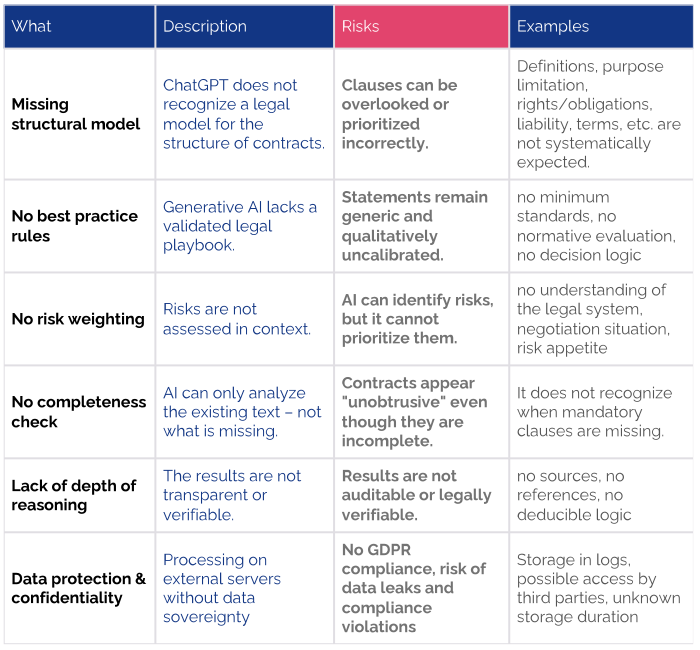
To better understand the practical limitations, it helps to look at the core weaknesses.
1. Missing Contract Structure
ChatGPT does not work with a defined model of how a contract must be structured.
It does not know which components are mandatory, such as:
- definitions
- purpose / objective
- rights and obligations
- confidentiality
- liability
- term and termination
- return or deletion of information
Unusual wording or non-standard formatting can be overlooked.
Its analysis results from statistical patterns, not legal structural logic.
👉 Legal structure review ≠ statistical text analysis.
2. No Best-Practice Standards
Beyond the missing structure, generative AI lacks any legal evaluation framework.
It has no legally curated playbook.
It lacks:
- binding minimum standards
- validated review rules
- normative legal reasoning
- systematic contract-law models
- risk-based "If X is missing → Y is risky" logic
ChatGPT generates generic descriptions based on training patterns.
It does not know what a complete or high-quality clause must contain—and cannot apply any quality standards.
Test Legartis for free - with the NDA Best Practice Playbook!
3. No Risk Levels
Another major limitation: ChatGPT cannot evaluate the severity of findings.
Legal risk assessment depends on:
- jurisdiction
- company policies
- experience
- negotiation context
- operational requirements
- risk appetite
A language model knows none of these.
Therefore, ChatGPT cannot:
- weight risks
- set priorities
- distinguish legal vs operational risk
- define minimum requirements
It may describe potential issues, but cannot judge how relevant they are.
4. No Completeness Check
A critical limitation:
ChatGPT cannot determine whether something is missing in a contract.
It can only analyse the text it sees.
It cannot identify:
- missing mandatory clauses
- incomplete contract structures
- omitted essential information
- absent definitions, purpose sections or deadlines
Generative AI works descriptively—not evaluatively.
It can say what is present, but not what must be present.
5. Lack of Transparency and Traceability
Another structural issue: ChatGPT’s results cannot be reliably traced.
It cannot explain why something is risky.
It provides:
- no legal references
- no documented review process
- no standardised framework
- no transparent reasoning
Its answers stem from statistical probabilities, not legal logic.
The output often sounds plausible—but cannot be verified.
6. Data Protection & Confidentiality Concerns
A further critical aspect involves the handling of confidential data.
When contracts are uploaded or pasted into generic AI tools, the following typically happens:
- Data is transmitted to and processed on the provider’s servers.
- Inputs may be stored in logs, depending on the product.
- In some configurations, inputs may be used to improve the model.
- Data often resides outside the organisation’s infrastructure—frequently in the US, sometimes partly in the EU.
Even when providers promise not to train on user data, key questions remain:
- How long is data stored?
- Who has internal access?
- How are logs secured?
- Can all data truly be deleted on request?
For confidential contracts—customer data, employee information, IP-related content or strategic agreements—this means:
Real loss of control and limited transparency.
Specialised Legal AI tools like Legartis address this directly:
Contract data is processed in controlled environments, with CH/EU hosting, contractual safeguards and no use for model training.
Legal AI vs ChatGPT: Fundamental Differences
These methodological weaknesses are reflected clearly in a direct comparison.
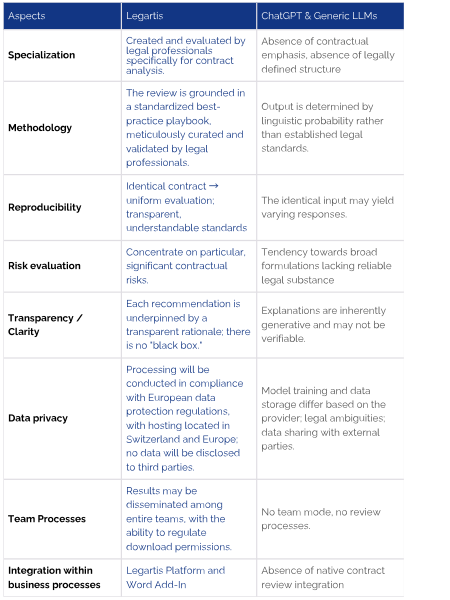
In short:
➡️ Generative AI writes and explains.
➡️ Legal AI reviews.
When ChatGPT Can Still Be Useful
Despite the limitations, ChatGPT can be a valuable helper for tasks such as:
- explaining clauses
- summarising contract sections
- translations
- stylistic improvements
- drafting alternative wording
Not suitable for:
- risk analysis
- legal evaluation
- completeness checks
- prioritisation
- approval decisions
How Companies Review Contracts Safely with AI Today
For genuine contract review, organisations increasingly rely on specialised Legal AI systems, because they:
- enable structured contract analysis
- provide clear, evidence-based recommendations
- prioritise risks
- detect missing elements
- deliver reproducible results
- support team collaboration
- ensure CH/EU-compliant data processing
Test Legartis for Free – and Experience the Difference
With Legartis, you can:
- review contracts quickly and systematically
- receive clear, traceable recommendations
- identify missing or risky clauses
- ask questions directly to the integrated AI assistant
- collaborate across teams
- analyse documents securely and CH/EU-compliantly
Discover a smarter way to review NDAs — free with Legartis.
Conclusion: ChatGPT Explains – Legal AI Reviews
ChatGPT is a powerful language model and useful for drafting or understanding contract language.
But reliable contract review requires more than linguistic ability:
It demands:
- legally defined review standards
- structural requirements
- explicit risk prioritisation
- completeness checks
- traceable, transparent reasoning
- documented review processes
- and secure, compliant data handling
Generative AI cannot provide these. Legal AI like Legartis closes this gap. It combines legal expertise with technological precision—enabling structured, reproducible and secure contract review.
Explore Related Insights
More articles related to this topic



Start withLegartis Today!
Talk to us about your business case or test Legartis right away!
