
AI Policy Template: What to Include When AI Goes Beyond Writing and Starts Acting
Table of contents
Most templates regulate what goes into a chat window. In 2026, AI tools also send emails, change data and review contracts. This article sets out what an AI policy needs for that, with clauses you can adapt and the steps to roll it out.
An AI policy defines which AI tools employees may use, what data they may process, for which purposes, and who is responsible for the outcomes. It translates data protection requirements, trade secret, confidentiality and professional secrecy obligations, and the duties under the EU Artificial Intelligence Act (EU AI Act) into practical rules that guide employees in their daily work: Can I enter this here? Can I use the result as it is?
Most templates focus on what may be typed into a chat window. That still matters, but in 2026 it is no longer enough. AI tools now send emails, file documents, review contracts and assign tasks. An AI policy therefore needs a second layer: which actions AI may perform, which standards it must follow and when a human decision is required.
Looking for a template? Go straight to ten template clauses for your AI policy, including rules for AI agents and example rows for the list of approved tools.
Is an AI Policy Legally Required?
No law explicitly requires an AI policy. It does, however, help companies turn duties from AI law, data protection and employment law into clear rules for employees. Several of these duties are hard to meet without written rules and even harder to prove:
- AI literacy (Article 4 AI Act): Deployers take measures to support the development of AI literacy among their staff and other persons dealing with AI systems on their behalf. This wording has applied since the amendment introduced by Regulation (EU) 2026/1744. Before that, deployers had to take measures to ensure, to their best extent, a sufficient level of AI literacy of their staff and other persons dealing with AI systems on their behalf. The duty itself has applied since 2 February 2025. A written policy and documented training provide a practical way to demonstrate these measures.
- Prohibited practices (Article 5): Certain AI practices have been prohibited since 2 February 2025. In the workplace, these include, for example, AI systems that infer employees' emotions, such as from facial expressions or voice, except for medical or safety reasons (Article 5(1)(f)). The policy should exclude such purposes explicitly.
- Transparency (Article 50(4)): Since 2 August 2026, deployers disclose when they use AI to generate or manipulate deep fakes. These are images, audio or video that resemble existing persons, objects, places, entities or events and would falsely appear to a person to be authentic or truthful. For evidently artistic, creative, satirical, fictional or analogous works or programmes, disclosure of the existence of such content in an appropriate manner that does not hamper the display or enjoyment of the work is sufficient. Deployers must also disclose AI-generated text published to inform the public on matters of public interest. That duty does not apply if the text has undergone human review or editorial control and a natural or legal person holds editorial responsibility. Based on the wording of the provision, ordinary advertising copy is unlikely to fall within its scope. For communications and marketing, the policy should therefore primarily address the disclosure rules for deep fakes, including the lighter form for evidently artistic or creative works. Whether a marketing campaign qualifies must be assessed case by case.
- High-risk use (Article 26): AI systems intended, for example, to filter job applications or to help decide on promotions are high-risk under Annex III point 4, subject to the exceptions in Article 6(3). These exceptions do not apply where the system profiles natural persons, which is usually the case for such tools. Additional deployer obligations apply to them from 2 December 2027. They include the duty of deployers who are employers to inform workers' representatives and the affected employees before putting the system into service or using it at the workplace (Article 26(7)). The policy should make such uses subject to prior approval. Our article on legal workflow software describes the deployer obligations in detail.
- Data protection: Entering personal data into an AI tool requires a legal basis on the part of the organisation and, as a rule, a data processing agreement with the provider (Article 28 GDPR) and, where a high risk is likely, a data protection impact assessment (Article 35 GDPR). If personal data is processed or accessed outside the EU/EEA, for example by the provider or its sub-processors, the rules on transfers to third countries apply as well (Articles 44 et seq. GDPR). Decisions based solely on automated processing that significantly affect people are only permitted within narrow limits (Article 22 GDPR).
- Trade secrets: In Germany, information is only protected as a trade secret if the company has taken appropriate secrecy measures (section 2 no. 1(b) Trade Secrets Act, GeschGehG). A rule on what must not go into publicly available AI tools can form part of those measures.
- Professional secrecy: Information subject to professional secrecy entails additional requirements when selecting providers and imposing confidentiality obligations: in Germany under section 203 of the Criminal Code (StGB) and, for lawyers, section 43e of the Federal Lawyers' Act (BRAO); in Switzerland under Article 321 of the Swiss Criminal Code. A data processing agreement alone is not enough. Section 43e BRAO requires, among other things, that the provider is bound to confidentiality in text form and, where the service directly serves an individual mandate, the client's consent. If the service is provided abroad, the protection of secrets there must be comparable to the protection in Germany (section 43e(4) BRAO).
Switzerland has no dedicated AI act. The Federal Council intends to ratify the Council of Europe's AI Convention and to adapt individual laws in a targeted way. According to the Federal Data Protection and Information Commissioner (FDPIC), the Data Protection Act already applies directly to AI-supported data processing. Automated individual decisions trigger a duty to inform (Article 21 FADP), and an employer may only process employees' personal data where it concerns their suitability for the job or is necessary to perform the employment contract (Article 328b Code of Obligations). The EU AI Act can also apply to Swiss companies, for example where the output of an AI system is used in the EU (Article 2(1)(c)).
The practical reason often weighs more than the legal one. Without rules, employees use private accounts and free tools nobody has vetted. Bans alone do not prevent this shadow AI. Companies also need approved tools that cover what people actually need to get done.
What an AI Policy Should Include: Ten Building Blocks
A workable AI policy answers three questions before anyone opens a tool. Which tool may I use? Which data may I enter? Who checks the result? The ten building blocks cover these questions, and block 7 adds the rules for AI that acts on its own.
- Scope and definitions. Who does the policy apply to, including contractors and temporary agency workers? What counts as an AI tool: only chat assistants, or also AI features inside existing software such as Office, CRM or translation?
- Ownership. A named person or role owns the policy, approves tools and decides on exceptions. A committee alone does not establish clear accountability.
- Approved tools. A list of permitted tools, each with licence, permitted data classes and purpose. The policy should also define a clear approval process for new tools, covering contracts, data location, training on customer data, subprocessors and access rights.
- Data classes. Which data may go into which tool, for example as a traffic light. This includes a clear rule for "anonymised": removing a name is not enough if the project, location or contract details still identify the person.
- Permitted and excluded purposes. The policy should list typical permitted tasks with examples. It should also name the excluded purposes: practices prohibited under Article 5 of the EU AI Act, decisions about people based solely on automated processing that have legal or similarly significant effects (Article 22 GDPR), and high-risk uses without prior approval.
- Review and labelling of results. Anyone who uses a result checks it like their own work. The policy sets out when a subject-matter expert reviews it as well and when a result must be labelled, for example under Article 50(4).
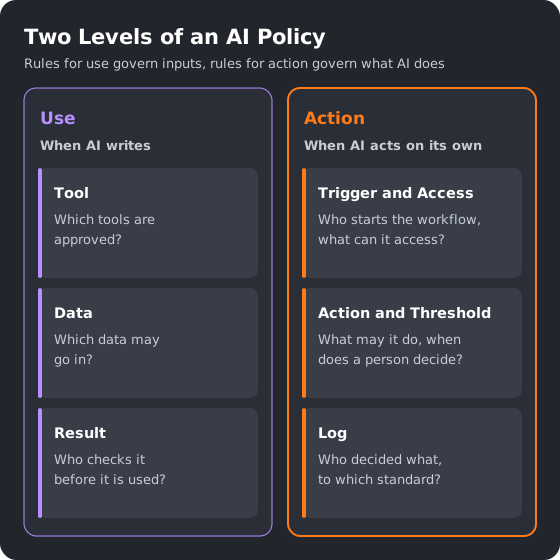
- AI that acts. Agents and automated workflows need their own rules covering permitted actions, applicable standards, thresholds for human approval and the logging of every action.
- Training. What employees need to know before they use a tool, and how attendance is recorded. This also helps demonstrate compliance with Article 4.
- Reporting. Who reports to whom if confidential data has ended up in the wrong tool, an AI output has gone to the wrong recipients or a result has caused harm? A personal data breach is reported to the supervisory authority without undue delay and, where feasible, within 72 hours of the company becoming aware of it, unless it is unlikely to result in a risk (Article 33 GDPR). In Switzerland, the duty to report only applies where a high risk is likely, and then as soon as possible (Article 24 FADP). The faster the internal report, the easier it is to meet the deadline.
- Review of the policy. A fixed date, at least once a year, and clear triggers for an earlier update: a new tool, a new purpose, a tool that no longer just writes but acts, a change in the law, an incident.
Block 4 has the greatest impact on everyday use. Employees decide in seconds whether to enter something. They do not need statutes for that, but a classification they can remember. A data traffic light with three levels does exactly that.
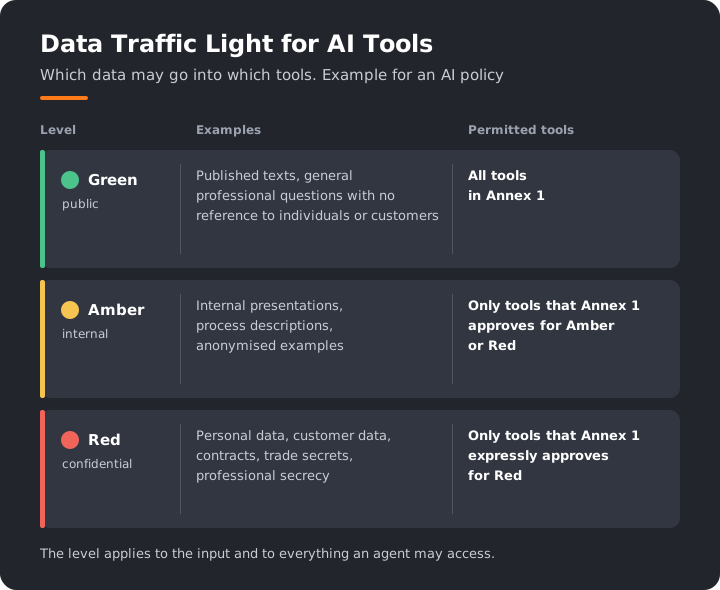
The traffic light does not replace vetting the tool. It only works if the list from block 3 states, for each tool, up to which level it is approved.
AI That Acts: What the Policy Must Cover for Agents
A chat assistant writes a draft that a person reads. An agent sends the email. Once AI starts taking action, the risks extend beyond data input, and rules designed for chat-based tools are no longer sufficient. The law adds the question of attribution: a statement an agent makes on behalf of the company, such as a commitment by email, is generally attributed to the company. For every workflow in which AI acts autonomously, the policy should define four elements and establish an audit trail:
- Who may trigger the workflow? Not everyone in the company should be able to start every workflow. Sales starts different workflows from Procurement.
- What may the workflow access? The policy sets out for each workflow, not across the board, which folders, templates, playbooks and systems it may read.
- Which actions may it carry out? Reading information and preparing drafts are fundamentally different from sending messages, modifying data or assigning tasks. Every action has a threshold: the defined condition at which the workflow stops running on its own and a person decides. That can be an amount, a contract clause the playbook does not provide for, or a result that cannot be classified clearly.
- Who may change the workflow's rules? Only the person responsible for a workflow changes its standards and thresholds. Every change is recorded with date and name.
An audit trail provides the necessary traceability. Which workflow handled which matter, to which standard, with which result, and who decided at the threshold? Without that trail, an error can neither be found nor explained. If the log attributes actions to individual people, however, it is also objectively capable of monitoring them. In Germany, the works council then generally has a right of co-determination, whatever the log is meant for. Where a works council exists, who may analyse the log and for what purpose therefore belongs in a works agreement, not in the policy alone.
What such workflows look like in a legal department is shown in our seven AI agents that take work off legal teams. What Legal must be able to prove once agents are at work is covered in Governing Agentic Legal AI.
AI Policy Template: Clauses You Can Adapt
The following ten clauses provide a starting point for your company's AI policy. They are not a complete, ready-to-use policy. Replace the placeholders in square brackets and have the draft reviewed by Legal, data protection and, where applicable, the works council. The numbers follow the ten building blocks above. You can also download the template for free as a Word file with the tool list, data traffic light, table for AI workflows and rollout checklist.
1. Scope. "This policy applies to all employees of [Company] and to temporary agency workers deployed at [Company]. For external persons who use AI tools on behalf of [Company], it applies where their contract refers to it. AI tools are applications that use artificial intelligence methods to generate text, images, code or analyses or to carry out actions, including as a feature within other software."
2. Ownership. "[Role, for example Head of Legal] is responsible for this policy. [Role] maintains the list of approved tools in Annex 1 and decides on exceptions."
3. Tools. "Only tools listed in Annex 1 may be used for work-related purposes, and only with a [Company] account. Private accounts are not permitted for work content. Employees request new tools from [Role]."
4. Data. "Annex 1 sets out, for each tool, the highest data level it is approved for. Level Green covers publicly available information and general questions without reference to individuals or customers; it may go into all tools in Annex 1. Level Amber covers internal information; it may only go into tools approved for Amber or Red. Level Red covers personal data, customer data, contracts, trade secrets and information covered by professional secrecy; it may only go into tools expressly approved for Red. For information covered by professional secrecy, the provider must additionally be bound to confidentiality in text form; [Role] checks whether further requirements apply, such as consent. Data is considered anonymised only if no individual can be identified any more, including through the project, location or contract details."
5. Purposes. "Emotion recognition in the workplace and any practice prohibited under Article 5 of the EU AI Act are excluded. AI systems that help decide on hiring, promotion, termination, task allocation or the performance of employees may only be used once [Role] has approved the use in advance. This approval does not replace the statutory obligations for high-risk systems. Decisions that significantly affect people are made by a person who reviews the output and can depart from it; they are never based solely on the output of an AI tool."
6. Review. "Employees check AI outputs for accuracy and completeness before use, as they would check their own work. Legal statements, contract changes and communications intended for customers or public authorities are additionally reviewed by a responsible subject-matter expert before use. Images, video and audio generated or altered with AI that resemble real persons, objects, places or events are labelled as AI-generated before publication."
7. AI that acts. "AI tools that carry out actions on their own may only be used in workflows approved by [Role]. For each workflow, the permitted actions, the applicable standards, the threshold for a human decision and the responsible person are defined. Every action is logged. Access to and permitted use of the logs are governed by [works agreement / internal rule of (date)]."
On clause 7: in Germany, a statement of purpose in the policy does not replace a works agreement. What matters for co-determination is whether the system is objectively capable of monitoring, not what it is meant for. In Switzerland, systems intended to monitor employees' behaviour are prohibited. Systems used for other purposes, such as logging AI actions, are permitted but must be proportionate and designed so that they do not harm employees' health (Article 26 ArGV 3).
8. Training. "Before using an AI tool for the first time, employees attend the training [title] and repeat it [annually / when significant changes occur]. Employees who use high-risk systems or approved AI workflows receive additional training. [Company] records attendance."
9. Reporting. "Employees report to [contact] without delay if confidential data has ended up in a tool that is not approved, an AI output has gone to the wrong recipients, an AI output has caused harm, or they suspect any other personal data breach."
10. Review of the policy. "This policy is reviewed at least annually and whenever new tools or purposes are introduced, existing tools gain autonomous capabilities, legislation changes or an incident occurs. The version dated [date] applies."
Annex 1, two example rows. "[Tool A] · company account · up to Amber · drafting and summarising texts · owner: [Role]" and "[Tool B] · company account with data processing agreement · up to Red, excluding information covered by professional secrecy · reviewing contracts against the playbook · owner: [Role]".
Implementing an AI Policy: Employee Consultation, Data Protection and Training
An AI policy only works once it reaches people and an approved tool is available for their tasks. Five steps can help put the policy into practice:
- Involve employee representatives from the start. In Germany, the works council must be informed at the planning stage, not once the tools have been chosen. The position in each country is set out below.
- Start small. Pick three frequent tasks, such as drafting texts, summarising minutes and answering questions about internal policies. Define the tool and the permitted data level for each.
- Bring in data protection early. The data protection officer, or whoever is responsible for data protection if no officer has been appointed, reviews the tools, the data processing agreement and, where necessary, the data protection impact assessment before the list in Annex 1 applies.
- Train and test with a real case. Two employees walk through a real matter using the policy. Wherever they hesitate, a rule or an example is missing.
- Make it easy to find. The policy should be easily accessible in employees' everyday workflows, with a designated contact available to answer questions promptly. Otherwise, in case of doubt, everyone decides for themselves.
Works Councils and Employee Representatives in Germany, Austria and Switzerland
Germany. The employer informs the works council in good time about the planning of working procedures and workflows, including the use of artificial intelligence, and consults it on their effects (section 90(1) no. 3 and (2) Works Constitution Act, BetrVG). The works council has a right of co-determination over technical devices designed to monitor the conduct or performance of employees (section 87(1) no. 6 BetrVG). According to the Federal Labour Court, it is sufficient that a device is objectively capable of monitoring; the employer's intention does not matter (for example BAG, decision of 16 July 2024, 1 ABR 16/23). Company accounts that attribute and store inputs by person are likely to meet that test. If the policy makes training mandatory and the training is a measure of in-company vocational training, the works council has a right of co-determination over how the training is conducted (section 98 BetrVG). If AI is used in drawing up selection guidelines for hiring, transfers, regrading or dismissals, the right of co-determination under section 95 BetrVG continues to apply (subsection 2a). Where the works council has to assess the introduction or use of AI, an expert is deemed necessary. The expert is still engaged by agreement with the employer (section 80(3) BetrVG).
The policy itself is a different matter. In summary proceedings, the Hamburg Labour Court held that rules on using ChatGPT concern how employees perform their work, which is not subject to co-determination, and not order and conduct in the workplace (section 87(1) no. 1 BetrVG). A duty to label AI outputs did not trigger co-determination under section 87(1) no. 6 either, because employees do the labelling themselves and no tool monitors them. In that case, employees used the tool through private browser accounts (decision of 16 January 2024, 24 BVGa 1/24). This reasoning cannot automatically be applied to company accounts with logging capabilities. It therefore makes sense to introduce the policy together with a works agreement on the tool.
Austria. Control measures and technical systems for monitoring employees that affect human dignity may only be introduced with the consent of the works council. That consent cannot be replaced (section 96(1) no. 3 Labour Constitution Act, ArbVG). Two further cases require consent, but here the arbitration board can replace it (section 96a ArbVG). The first concerns systems that process employees' personal data beyond general personal details and professional qualifications, unless the use does not go beyond obligations under statute, norms of collective labour regulation or the employment contract (subsection 1 no. 1). The second concerns systems designed to assess employees, insofar as they collect data not justified by the use in the business (subsection 1 no. 2). For AI that assesses performance or suitability, this is the most important case. If such a system also affects human dignity, section 96(1) no. 3 ArbVG applies as well, and consent then cannot be replaced. Where there is no works council, control measures that affect human dignity require the consent of each employee (section 10 AVRAG).
Switzerland. Swiss law has no works council in the German sense. Under the Participation Act, however, an employee representation is entitled to timely and comprehensive information (Article 9). Where there is no representation, these rights are exercised directly by employees (Article 4). Employees or their representatives also have participation rights on health protection (Article 48(1)(a) Employment Act, ArG). This includes Article 26 of Ordinance 3 to the Employment Act (ArGV 3): systems intended to monitor employees' behaviour at the workplace may not be used. Where monitoring systems are necessary for other reasons, they must not impair employees' health or freedom of movement (on the scope, BGE 130 II 425). Unlike in Germany, the purpose of the system is what counts for Article 26 ArGV 3. Article 328b of the Code of Obligations and the Data Protection Act apply regardless. For AI tools with logging, this question therefore belongs in the approval.
Why AI Policies Fail in Practice
Most AI policies fail not for lack of legal provisions but in how they are applied. Four mistakes are easy to avoid:
- A ban without an alternative. If you ban everything and approve no tool, you risk shadow AI on private accounts.
- Principles without examples. "Responsible use" does not help anyone decide whether customer meeting notes may go into a tool.
- No owner. Without a name, every request for an exception stalls and the tool list goes out of date.
- Only the input is regulated. The policy covers the chat window but not the agents that already send emails in the same company.
How Legartis Applies an AI Policy Day to Day
Vendor example: we use Legartis to illustrate how an AI policy can be applied in practice, focusing on capabilities we can substantiate publicly.
An AI policy has limited value if employees have to search for it and interpret its requirements before taking action. In the agentic Legal AI Workspace from Legartis, recurring workflows are called Frequent Actions. They are part of the Legal Agent and follow your standards, drawing on playbooks, guidelines, templates and legal sources as required. A Frequent Action can, for example, check requests about using AI tools against your AI policy and assign cases that need an additional decision to the responsible person. The result remains a proposal that the responsible person reviews, and Legartis keeps a complete audit trail.
Applying the vendor assessment criteria from block 3 to Legartis: Legartis processes data in Switzerland and the EU, in compliance with the GDPR, and does not train any model on customer data. Legartis is ISO 27001 certified. You can see how Frequent Actions work day to day on the Legal Workflow Automation page.
Book a demo: we will show you how a workflow in the Legal Agent works to your standards, where it assigns a matter to a person and what the audit trail records.
As of November 2026. We checked the legal statements in this article against the statutory texts with the Legartis Legal Agent. Tereza Latova, Legal Engineer at Legartis, then approved them. This article does not replace legal advice on individual cases.
FAQ
Frequently asked questions
No law requires a document with that name. Since 2 February 2025, however, the EU AI Act has regulated AI literacy (Article 4) and prohibited certain practices (Article 5). Under the current wording of Article 4, deployers take measures to support the AI literacy of their staff. Additional obligations arise under the GDPR and, in Switzerland, the FADP. In Germany, information is only protected as a trade secret if appropriate secrecy measures have been taken (Trade Secrets Act). A written AI policy is an obvious way to implement these duties and to demonstrate compliance.
Ten building blocks: scope, ownership, approved tools, data classes, permitted and excluded purposes, review and labelling of results, rules for AI that acts on its own, training, reporting and review of the policy. Day to day, the most important parts are the list of tools and a data traffic light that says which data may go into which tool.
Often not the policy itself, but frequently the AI tool it governs, because introducing the tool can trigger co-determination rights. According to a decision of the Hamburg Labour Court in summary proceedings, rules on how employees use AI at work concern how they perform their work, which is not subject to co-determination (24 BVGa 1/24). If the tool is objectively capable of monitoring conduct or performance, for example through logs by user, the works council has a right of co-determination under section 87(1) no. 6 BetrVG. As a rule, it must be informed about the planning (section 90 BetrVG). In Austria, sections 96 and 96a ArbVG apply; in Switzerland, the Participation Act and Article 26 ArGV 3.
Yes, if the AI policy allows it and the conditions are met: a company account, a data processing agreement, contractual safeguards excluding the use of your content for model training and, where data is processed or accessed outside the EU/EEA, a basis for the transfer to a third country. A tool can then be approved for internal information. Personal data and contract content only belong in tools expressly approved for that data class. What this means for contract review is covered in our article Contract Reviews with ChatGPT.
At least once a year, and whenever a new tool is added, a tool gains new features, the law changes or an incident has occurred. The most important moment is when a tool no longer just drafts text but acts on its own. The responsible person then reviews the approval again.
Explore Related Insights
More articles related to this topic



Start with Legartis Today!
Talk to us about your business case or test Legartis right away!