
Seven AI Agents That Take Work Off Legal Teams
Table of contents
Most lists of AI agent examples cover customer service, sales and finance. Legal is missing from almost all of them. Here are seven from legal teams, each with trigger, process, boundary and result.
Updated 9 September 2026, first published 9 April 2025.
Most lists of AI agent examples run to thirty or fifty use cases across customer service, sales, finance and HR. Legal appears occasionally. What is usually missing is how the agent actually operates: what triggers it, how far it may go on its own, who takes over at the boundary and what it delivers at the end.
Legal is a good place to answer those questions. The work comes in recurring patterns, the rules are already written down in playbooks and templates, and the question of where a person has to decide is sharper here than anywhere else in the business.
So here are seven examples, all from legal teams. Each one follows the same four-part structure: trigger, process, boundary and result.
What an AI agent is, in one paragraph
An AI agent takes a task and works towards an outcome across multiple steps, using the tools, data and systems available to it. In legal work, that is not enough. The agent also needs a defined standard and a clear decision boundary: what it may handle on its own, and where a person must take over. How that boundary works in detail, and how the EU AI Act treats it, is covered in our article on AI agents in the legal department. You can see how Legartis has built its own Legal Agent on the product page. The rest of this article is about the cases.
Seven examples of AI agents in the legal department
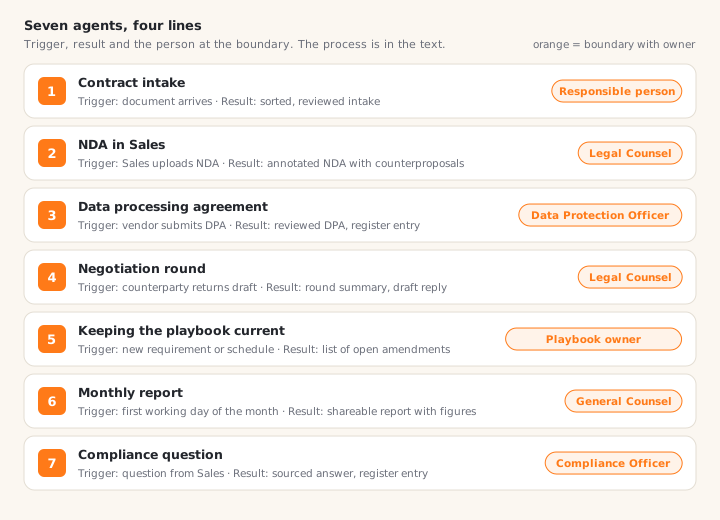
1. The intake agent
A document arrives, and the agent knows what it is before anyone opens it.
Trigger: A contract or a request comes in, uploaded by a business unit or passed on from a connected system.
Process: The agent identifies the document type, the responsible team and the matching playbook. An NDA from Sales gets the NDA playbook, a framework agreement from Procurement gets the supplier playbook. It reviews the document against that standard and prepares it.
Boundary: It decides nothing. It places the reviewed document with the person responsible for that document type, together with a summary of the deviations.
Result: Instead of an inbox full of unopened attachments, a sorted intake where every document has already been reviewed and sits with the right person.

2. The NDA agent for Sales
Sales gets its NDA reviewed straight away, without raising a ticket with Legal.
Trigger: A sales rep uploads a prospect's NDA to her own workspace.
Process: The agent checks every clause against the NDA playbook Legal has approved: term, definition of confidential information, return obligations, governing law. It marks anything within the approved positions as acceptable. Where a fallback position exists, it drafts the counterproposal in the playbook's own wording.
Boundary: If the counterparty demands a contractual penalty or a right the playbook does not cover, the agent stops on that point and escalates it to the responsible Legal Counsel, together with the requirement it breaches.
Result: An annotated NDA with counterproposals that Sales can take back to the prospect. Legal sees only the one point that needs a decision.
3. The data processing agreement agent
Every new software vendor brings its own data processing agreement. The agent reviews it before the privacy team sees it.
Trigger: IT or Procurement submits a vendor's data processing agreement.
Process: The agent checks it against the data protection playbook: subject matter and duration of processing, processing on documented instructions, subprocessors, deletion periods, technical and organisational measures. Where the vendor's template departs from yours, it flags the passage and proposes your wording.
Boundary: If the agreement provides for a transfer to a third country without standard contractual clauses, or names subprocessors outside the approved list, the agent stops and escalates the point to the Data Protection Officer. Everything else goes through.
Result: A reviewed agreement with marked deviations and counterproposals and, where required, the entry in the internal vendor or data protection register. The privacy team sees only the cases that require a decision.
4. The negotiation round agent
Between two rounds of negotiation, the agent prepares the next one.
Trigger: The counterparty returns a revised draft.
Process: The agent compares the versions, identifies every change and checks it against the playbook. For each deviation it proposes the next fallback position Legal has defined in advance. It summarises what the other side has accepted, what remains open and what is new.
Boundary: It does not negotiate. It prepares the round, and the responsible person decides which fallback position to offer and where to hold the line.
Result: A summary of the round, the annotated draft with proposed positions, and a draft reply. The review that precedes this step is described under AI Contract Review.
5. The agent that keeps the playbook current
Standards go stale quietly. This agent notices.
Trigger: A new regulatory or case law requirement is added, or a scheduled check runs, once a quarter for instance.
Process: The agent reads the existing playbooks against the new requirement and finds the positions that contradict it or fail to cover it. For each passage it drafts a proposed amendment in the playbook's style. How a playbook is created in the first place is shown by the Contract Playbook Creator.
Boundary: It does not change the playbook. Every proposal goes to the person who owns the playbook and becomes the standard only with their approval.
Result: A list of open amendments with reasons, instead of a playbook nobody has touched for two years.
6. The monthly report agent
At month end, the report is ready without anyone having to request it.
Trigger: A schedule, the first working day of the month for example.
Process: The agent analyses the entire contract portfolio against a predefined question: what is the total liability exposure from active contracts, how many contracts have no liability cap, which clauses deviate from the standard most often. It turns the answers into a report with figures, tables and next steps.
Boundary: The report does not judge what is acceptable. The General Counsel who reads it does. Every figure in the report can be traced back to the contract clause it came from.
Result: A shareable report that people without access to the contract system can read. How such reports are built is described under Contract Insights.
7. The compliance question agent for business units
Not every matter is a contract. Sometimes it is a question that would otherwise land in Legal's inbox.
Trigger: A sales rep asks, in the workspace Legal has set up for Sales, whether they may accept a customer's invitation to an industry event.
Process: The agent reads the company's gifts and hospitality policy, checks value, occasion and counterparty against the rules set out there, and drafts the answer with a reference to the relevant passage in the policy. It records the request and the answer in the register the policy requires.
Boundary: If the value exceeds the threshold in the policy, or the counterparty is a public authority, the agent does not answer itself. It escalates the request to the Compliance Officer, together with the rule that requires approval.
Result: A sourced answer within minutes, an entry in the register, and a Compliance Officer who sees only the cases above the threshold.
What the seven examples have in common
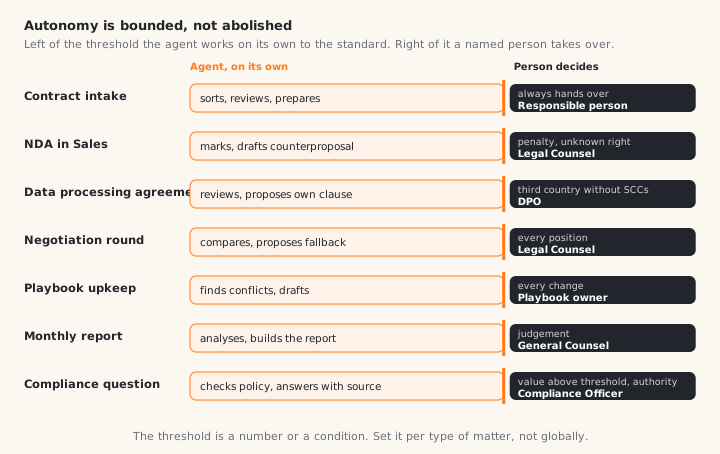
All seven follow the same pattern, and the pattern matters more than any single example. The agent has a task that someone described once. It works to a standard Legal has set, usually a playbook, a template or a policy. And it has a boundary with a role behind it: Legal Counsel, Data Protection Officer, Compliance Officer, General Counsel, the person who owns the playbook.
What stands out is not that a human takes every decision. What stands out is that autonomy has clear limits. Below a threshold defined in advance, the agent works on its own to the standard it was given: it marks the acceptable position, drafts the counterproposal, produces the report. Where that space ends, a named person takes over. That is what makes these examples so easy to describe. If you cannot define the boundary, you do not have a use case. You have a risk. What a legal department must additionally be able to prove once agents are running is covered in our article on governing agentic Legal AI.
Which factors to consider when introducing AI agents
Whether an agent removes work or creates more of it comes down to five factors, and all five are visible in the examples above.
The standard before the agent. Every one of the seven examples needs a playbook or a template for the agent to work against. Without that standard, the agent falls back on model knowledge, your input and whatever context is available, instead of binding company positions. So the rollout begins with a question: which standards already exist in writing, and which still live in the heads of individual lawyers?
A first case with a clear boundary. Start with the process whose boundary is easiest to express as a number. The NDA in Sales is the obvious entry point: few clauses, a contractual penalty as a clear threshold, and a result you can see immediately.
An owner behind the boundary. Name a person for every threshold before you start, so nobody has to ask who owns an escalated point. A department is not an owner.
The output format. Decide what comes back: an annotated draft, a file in the house layout, a report. An agent that ends with an answer in a chat window creates a second step of work.
The measurement. Two numbers are enough to begin with: how many matters the agent completed without any escalation, and how reliably it identified each individual requirement. The second number tells you which thresholds to tighten. How to measure quality per requirement is explained on our AI Quality page.
Which authorisation features AI agents need
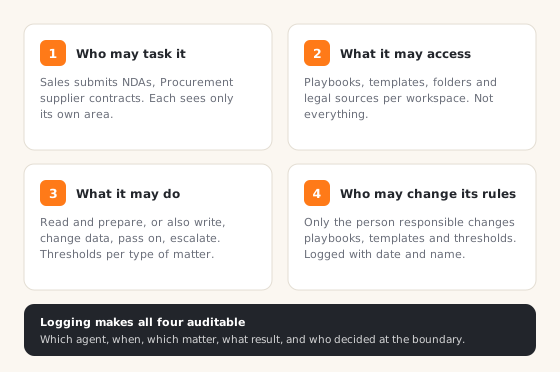
An agent that runs matters needs four kinds of permission, each configurable on its own.
Who may task it. Not everyone in the company should be able to trigger every process. Sales submits NDAs, Procurement submits supplier contracts, and each sees only its own area.
What it may access. Which playbooks, templates, folders and legal sources the agent can reach is set per workspace. An agent for Sales has no business seeing employment contracts.
Which actions it may perform. Can the agent only read and prepare, or can it also write documents, change data, forward results or escalate? For sensitive actions you add thresholds and approvals, per type of matter rather than globally. The threshold from the examples decides under which conditions an action may run without approval.
Who may change its rules. Only the person responsible for a playbook, template or threshold may change it. Every change is recorded with date and name, or nobody can later say which standard a matter was handled under.
Logging sits alongside these four. It is not a permission, but it is what makes the four auditable: which agent handled which matter, when, with what result, and who decided at the boundary.
What we predicted in 2025, and what came true
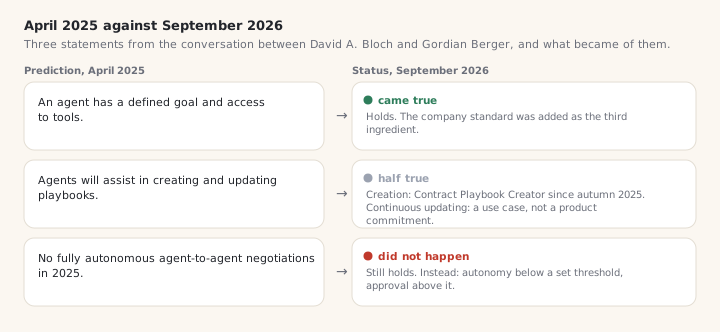
This article began as a conversation between David A. Bloch and Gordian Berger, CEO and CTO of Legartis, recorded in April 2025. Three statements from it deserve a second look.
Gordian Berger's definition of the agent has held. "In contrast to a typical language model that answers user prompts based solely on its training data, an AI agent has a defined goal or task, and access to tools that help it achieve that goal." What has been added since is the standard as a third ingredient: goal, tools and the company's own rules.
His prediction on playbooks came half true. "Many companies rarely update their contract guidelines or policies. With our system, agents will assist in creating or updating these internal policies." Creation happened: since autumn 2025 the Contract Playbook Creator has been building playbooks from existing documents and requirements. Continuous updating against new regulatory requirements remains a use case like the fifth example above rather than a product commitment. Keeping playbooks current is Legal's responsibility today.
His caution on autonomy still holds. "I don't see fully autonomous agent-to-agent negotiations happening this year." What happened instead is what the seven examples show: agents run matters to a standard and escalate at a set boundary. Autonomy exists below the threshold, not beyond it. That is less spectacular than two agents negotiating a contract, and far more useful to a legal department.
Conclusion: the example is the boundary
The best test of an AI agent is whether you can describe exactly how it works. What triggers it? What does it do? Where does its authority end? And what does it deliver? If those questions have clear answers, you have an agent. If all you can describe is what it might do, you probably have a chatbot with tools.
The Legal Agent by Legartis is built on this pattern, inside the Legal AI Workspace, where playbooks, templates and reports live in one place. If you would like to see one of the seven running on your own documents, book a demo.
FAQ
Frequently asked questions
An agent that receives an NDA from Sales, checks it against the legal department's NDA playbook, marks acceptable deviations, drafts counterproposals in the playbook's wording and escalates only the clause the playbook does not cover to Legal. Sales gets the annotated version immediately, and Legal sees one point instead of the whole contract.
AI agents are systems that work through a task over several steps instead of answering a single question. They use tools such as document access, comparison or reporting, keep to a given standard, and escalate anything outside that standard to a person for a decision.
Five: a written standard for the agent to work against, a first case with a clearly measurable boundary, a named person behind every threshold, a defined output format instead of a chat answer, and two measures from day one: the share of matters completed without escalation and the reliability per requirement.
Four, each configurable on its own: who may task the agent, which playbooks, templates and sources it may access, what it may do without approval, and who may change its rules. Plus logging that records which agent handled which matter, when, and who decided at the boundary.
Yes. The seven examples in this article come from corporate legal departments, because playbooks and business units make the pattern especially clear there. The same pattern of task, standard, boundary and result applies to law firms, for instance in client intake, deadline control or preparing negotiation rounds. What AI does for lawyers in detail is covered on our AI Lawyer page.
Explore Related Insights
More articles related to this topic



Start with Legartis Today!
Talk to us about your business case or test Legartis right away!