
Governing Agentic Legal AI: What GCs Must Be Able to Prove
Table of contents
The question is no longer whether AI can do legal work, but whether legal can prove what an agent did, on what basis, and who approved it. A framework for governing agentic legal AI.
In many legal departments, the conversation has moved beyond basic LLM experimentation. Agents now route intake, triage contracts, monitor regulatory feeds, draft first-pass responses to privacy requests, and review outside-counsel invoices. The technology question is becoming less interesting than the governance question.
Many legal teams can tell you which AI tools they use. Far fewer can show who approved them, what authority they hold, how decisions are documented, or how an output would hold up in an audit, a regulatory inquiry, or a board review.
Agentic legal AI refers to AI systems that don’t only answer questions but execute multi-step legal workflows — classifying requests, applying playbooks, routing exceptions, preparing outputs, and triggering approvals. The move from assistance to execution is what creates the governance problem.
It changes the work, too. The interesting problem is no longer moving from chat-based tools to agents that act. It is answering harder questions:
- How do you govern workflows that run end-to-end with minimal human touchpoints?
- How do you defend an automated decision when audit, regulators, or the board ask you to show your work?
- Who is accountable when an agent acts, applies a policy, or escalates an issue?
- How do you measure value without sacrificing transparency, oversight, or defensibility?
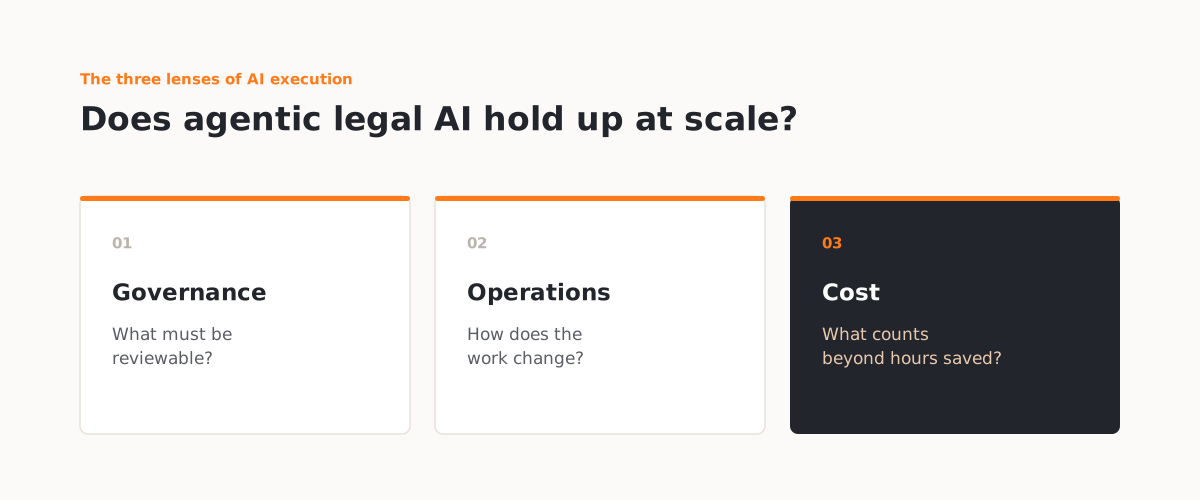
Three lenses decide whether AI execution holds up at scale: governance, operations, and cost.
What Agentic Legal AI Looks Like in Practice
Before the lenses, it helps to be concrete about where AI already runs. These workflows are not speculative. In many mid-to-large legal departments, at least some of them are already being piloted or prepared for production.
- Contract intake and triage. A request arrives through a self-service portal or email alias. An agent classifies it (NDA, MSA, vendor amendment, order form), pulls the counterparty record, checks for existing relationships and the applicable playbook, and routes it. Standard NDAs that match the approved playbook go back to the business with redlines; anything outside the playbook is routed to a named attorney with a summary of the deviation.
- Outside-counsel invoice review. An agent reads each invoice line against billing guidelines and historical patterns, flags block billing, partner time on associate-level tasks, and out-of-policy expenses, and proposes adjustments — a human approves, modifies, or rejects.
- Privacy request fulfilment. An agent validates identity, scopes the request, queries mapped systems of record, assembles the response package, and routes it for legal review before release, with statutory deadlines tracked against the workflow instance rather than someone’s calendar.
The point is not that these use cases are novel. It is that they now generate a record of decisions, approvals, and actions that rarely existed when the same work ran through email and spreadsheets. That record — process auditability — is what makes the three lenses possible.
The Governance Lens: What Must Be Reviewable
A legal AI system earns trust by being reviewable and auditable. The practical question is what “reviewable” means when an agent has just completed a twelve-step workflow with two embedded human approvals. In practice, it rests on five default artifacts:
- Scope of authority. Every agent needs a written charter: what it may do, what data it can access, what actions require human approval, and what it must escalate. This is the document you hand to internal audit.
- Approval gates with named approvers. Human-in-the-loop only works if the loop is specific. “Legal review required” is not a control. “Senior counsel in the relevant practice group approves before external release, recorded against the workflow instance” is a control.
- Decision provenance. For each consequential output, the record should show inputs used, the policy or playbook sections applied, material alternatives considered, and what changed between the agent’s recommendation and the final action.
- Override capture. When a human changes the agent’s recommendation, log the change and the reason. Patterns in overrides reveal where playbooks are wrong, training data is stale, or confidence is miscalibrated.
- Time-stamped action log. Every action, reminder, approval request, and escalation lives in one chronological record per workflow instance. This is what you produce when a regulator or court asks how a process ran.
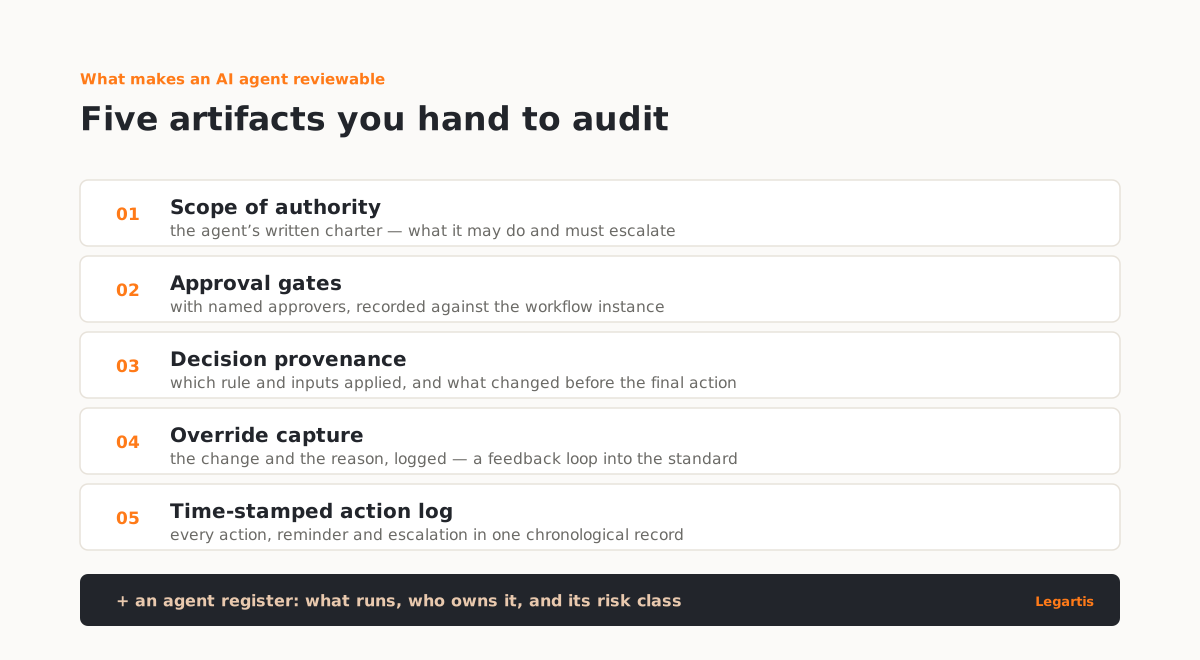
There is also a portfolio-level control. Agents are often launched by individual teams without a central register. That works at five agents; it fails at fifty. The GC’s office, with the CIO, should maintain an agent register — each production agent, its charter, owner, last review date, and risk classification — so leadership can answer the question it will eventually ask: what are we running, and who is accountable for each system?
This is the same standard we set out in our guide to auditable AI in legal work: documentation is not enough — quality and decisions have to be provable.
The Operations Lens: How the Function Changes
The operational impact is not just speed. The shape of the work changes, and the team changes with it.
- Attorney time moves from production to review. As agents take first-pass production on routine work, attorneys shift toward quality control, exception handling, and judgment on matters outside the playbook. That is a different skill set than many teams hired for — and a new development path for junior lawyers.
- Playbooks become the unit of investment. When an agent runs a workflow, the playbook is the asset. A precise, current playbook makes an agent useful; a vague or stale one makes it dangerous. Playbook maintenance becomes an ongoing discipline.
- The interface between legal and the business changes. When intake is structured and routed by an agent, the business stops calling a favourite attorney directly. That improves distribution and visibility — but governance has to improve service rather than add friction.
There is a quieter shift too: once agents log every step, the function gains a dataset it never had — cycle times per step, stall points, and the playbook sections that generate the most exceptions. Contract Insights turns that record into operational reporting. It is how companies like dormakaba and Implenia scale contract review with agentic legal AI without losing control of it.
The Cost Lens: What to Count, What Not to Overclaim
The cost case for legal AI is often overstated in vendor decks and understated in internal business cases — both from the same mistake: stopping at “hours saved.” Attorney hours are largely a fixed cost; saved hours don’t reduce spend unless headcount changes. A more credible model counts four things:
- Outside-counsel spend — where consistent, playbook-driven execution keeps routine work in-house.
- Cycle time on revenue-adjacent work — contracts that close in 14 days instead of 30 affect revenue recognition, deal velocity, and customer experience; often the strongest argument to a CFO.
- Risk-weighted exposure — more consistent execution reduces regulatory and compliance exposure.
- Total cost of the AI programme — integration, playbook maintenance, governance reviews, training, and monitoring — not just licences.
The cost lens also forces a question vendor decks avoid: what does it cost to get governance wrong? An unexplainable, undefendable automated decision is not a saving — it is a liability.
Where Legartis Fits: The Quality and Control Layer
The common thread across all three lenses is not automation itself. It is proof — proof of authority, proof of quality, proof of control, and proof of value. This is where Legartis fits.
Legartis is a Legal AI Workspace that translates legal standards into measurable, controllable, and auditable contract work. The five reviewability artifacts above are not add-ons to bolt on later — they are how the system is built:
- Decision provenance and a time-stamped log map directly to per-requirement traceability — every assessment tied to the clause, source, and rule behind it.
- Override capture is a feedback loop: corrections flow back into the standard instead of disappearing as comments.
- The playbook is the written standard an agent is measured against — not just a workflow guide, but the benchmark for quality.
- Quality scores, versioning, and the AI Quality System make reliability measurable per requirement, so a GC can prove how well the system performs on the things that matter.
That is the difference between AI that produces output and AI whose quality you can govern — the same line we draw between explainable and auditable AI. Agents give leverage; the quality and control layer makes that leverage defensible. This is what lets teams put legal AI agents and AI contract review into production across legal, procurement, and sales without losing accountability.
Foundation models make legal work more accessible. Legartis makes it reliable, controllable, and scalable across the enterprise.
Conclusion: Mature What You Already Run
The challenge for most legal departments is no longer deploying more agents. It is maturing the systems already in production: formalising governance, distinguishing production-ready workflows from pilots, and measuring value through operational and financial outcomes rather than time-saved estimates.
The next buying decision for legal teams will not be “which legal AI is the most powerful?” It will be:
Which legal AI can we be accountable for?
→ Download the Legal AI Guide 2026 to see how auditable, agentic legal AI works in practice — or book a demo to walk through the governance layer with our team.
FAQ
Frequently asked questions
Agentic legal AI refers to AI systems that don’t just answer questions but execute multi-step legal workflows — classifying and routing intake, reviewing contracts against a playbook, tracking obligations, or drafting first-pass responses — with defined human approval points. The shift from chat-based assistance to agents that act is what raises the governance questions in this article.
Through five reviewable artifacts per agent: a written scope of authority (charter), approval gates with named approvers, decision provenance, override capture, and a time-stamped action log — plus a central agent register maintained by the GC’s office and the CIO listing each production agent, its owner, risk class, and last review.
You produce the record: which rule or playbook section was applied, which requirement and contract provision were involved, whether a human approved or overrode the agent, and the time-stamped log of every action. Auditable legal AI is designed so that this record exists by default rather than being reconstructed after the fact.
Because when an agent runs a workflow, the playbook is the asset that determines quality. A precise, current playbook makes the agent useful; a vague or stale one makes it risky. Maintaining playbooks — ownership, review cadence, testing changes, feeding exceptions back — becomes a core operating discipline.
Attorney hours are largely a fixed cost, so saved hours rarely reduce spend unless headcount changes. A more credible model measures outside-counsel spend, cycle time on revenue-adjacent work, risk-weighted exposure, and the total cost of the AI programme — including the cost of getting governance wrong.
Explore Related Insights
More articles related to this topic


Start with Legartis Today!
Talk to us about your business case or test Legartis right away!