
Explainable AI in Legal Work: Definition, Value & Limits
Table of contents
Explainable AI has become a governance requirement in legal work. But explanation alone isn't enough: an output can be perfectly explainable and still miss your contract standard. Here is what explainable AI means for legal teams — and where auditable quality takes over.
For a long time, the debate around AI in legal work centred on capability. Could a model read a contract, summarise a clause, flag a risk, or draft a first version? That question is no longer theoretical. AI can support many of these tasks — often quickly and convincingly.
The question that now decides which tools legal teams actually trust is different:
Can you explain why the AI produced a given result — and can you stand behind that result?
This is where explainable AI enters legal work. In a field where every assessment may need to be justified — to a colleague, to the business, to an auditor, or to a regulator — a plausible answer is not enough. Legal teams, compliance functions, procurement, and sales all need to understand how a conclusion was reached before they act on it.
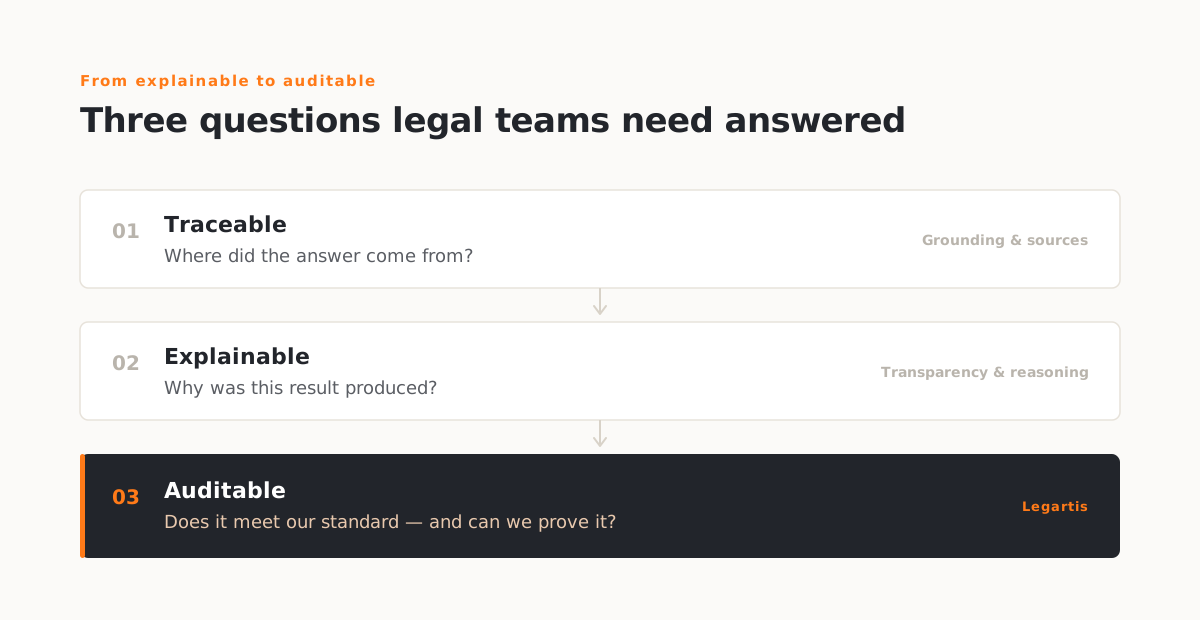
Explainability has therefore moved from a technical nice-to-have to a governance requirement. But as this article will show, explainability is necessary — and still not sufficient. For contract work at scale, legal teams need something more specific: quality that is not only explained, but measurable, controllable, and auditable against their own standards.
What Is Explainable AI (XAI)?
Explainable AI (XAI) refers to AI systems whose outputs can be understood and traced by humans — systems that make it visible why a particular result was produced, which inputs mattered, and how the model reached its conclusion. The opposite is a “black box”: a system that delivers an answer with no insight into the reasoning behind it.
In practice, explainability spans a few related ideas that are often used interchangeably but mean different things:
- Transparency — how open the system is about its data, logic, and limitations.
- Interpretability — how easily a human can follow the relationship between an input and an output.
- Traceability — whether an output can be linked back to specific sources, clauses, or rules.
A “glass-box” approach aims for outputs a human can inspect and follow. For legal work — and for explainable AI in contract review specifically — that usually means the ability to see which contract provision, source, or rule an assessment is based on, rather than a confident sentence with nothing behind it.
Why Explainable AI Matters for In-House Legal Teams
Explainable AI in legal work is not an abstract virtue. It maps directly onto how legal teams are held accountable.
Accountability. Legal must be able to justify a position — why a clause was flagged, why a risk was rated the way it was, why a deviation was accepted. An unexplainable output cannot be defended, and an assessment that cannot be defended cannot be relied on.
Regulation. Explainability is increasingly a legal obligation, not just good practice. The EU AI Act attaches transparency and human-oversight requirements to higher-risk uses of AI. Data protection law introduces expectations around meaningful information about automated decisions. And in regulated sectors, frameworks such as DORA push firms toward demonstrable control over the systems they depend on.
Not every legal AI use case falls into the same regulatory category. But the direction is clear: where AI supports decisions that affect risk, compliance, or business commitments, transparency, human oversight, and demonstrable control become increasingly important.
Business trust. When AI outputs are used not only by lawyers but by procurement, sales, and other business teams, those teams need to understand why the system reached a conclusion before they escalate, sign, or push back. Explainability is what makes an AI result usable beyond the legal department.
Explainable AI vs. Trustworthy AI: Related, Not the Same
Two terms tend to travel together — explainable AI and trustworthy AI — and they are easy to conflate. They are related, but they answer different questions.
Explainable AI is about understanding: can a human see why the system produced this output? It is a property of the system’s transparency.
Trustworthy AI is broader. It describes a set of qualities a system should have to be relied on responsibly — typically including transparency, fairness, robustness, safety, accountability, and human oversight. Explainability is one component of trustworthiness, not a synonym for it.
The practical implication for legal teams is important: an AI system can be explainable without being trustworthy. It can clearly show its reasoning and still be inconsistent, misaligned with your standards, or unreliable on the requirements that matter most to your organisation. Explainability tells you how an answer was formed. Trustworthiness asks whether you can depend on it. Neither, on its own, tells you whether the answer meets your contract standard — which is the question legal teams actually need answered.
The Limits of Explainable AI
Here is the distinction that matters most for contract work:
Explainable does not mean correct. And correct-sounding does not mean compliant with your standard.
An explanation can be perfectly clear and still lead to the wrong conclusion for your organisation. A system can show, transparently, that it based an assessment on a particular clause — and still misjudge that clause against your internal risk position. Explainability reveals the path to an answer. It does not confirm that the answer matches the standard you are actually held to.
For a single contract reviewed by an experienced lawyer, this gap is manageable — the lawyer catches it. But in-house legal work is increasingly about scale: hundreds of NDAs, procurement contracts, and vendor agreements reviewed across teams, often by non-lawyers. At that scale, “the output is explainable” is not the same as “the output is reliable, consistent, and defensible against our playbook.”
That is the gap between explanation and quality — and it is exactly where legal teams need to look next.
From Explainable to Auditable: The Four Quality Levels of Legal AI
A useful way to see where explainability sits is a simple ladder of quality maturity in legal AI.
Level 1 — Output Claims. The system is described as “accurate”, “trusted”, or “legal-grade”, with no verifiable system behind the claim. This is the weakest form of quality positioning.
Level 2 — Grounding & Sources. Outputs are linked to sources, citations, or contract provisions. This is where most explainable AI sits: it improves traceability and reduces free-floating statements. It is a foundation — not a complete quality system.
Level 3 — Workflow Controls. Playbooks, roles, approvals, audit trails, and human review are added. The AI is embedded in a working process, not used as a standalone chat.
Level 4 — Measurable AI Quality System. Quality can be measured, controlled, and improved per requirement, playbook, clause type, or contract standard — with quality scores, feedback loops, and versioning. This is the level at which legal AI moves from assistive technology to auditable legal infrastructure.
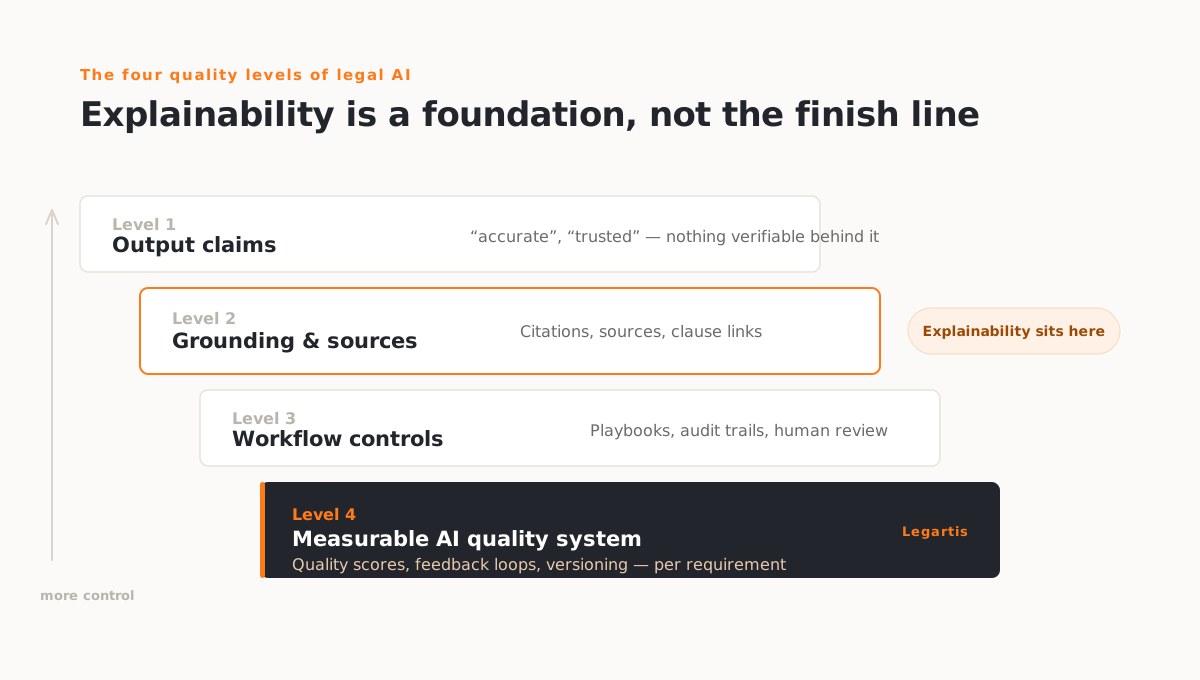
Explainability, on its own, typically reaches Level 2. It makes the reasoning visible. But visibility of reasoning is not the same as measurable, controllable quality. To close the gap the previous section described, legal teams need to operate at Level 4 — where the question is not only “can we see why?” but “how reliably does this meet our standard, and can we prove it?”
What Auditable Explainability Looks Like in Contract Work
Moving from explainable to auditable means giving explainability a standard to be measured against. In practice, that rests on six properties: measurable quality, control, traceability, consistency, continuous improvement, and audit readiness.
For contract work specifically, that translates into:
- Requirement-level transparency. Not just “here is the source”, but an assessment tied to a specific clause type, playbook rule, or contract requirement — so you can see how the AI performed on the thing you actually care about, not just in aggregate.
- A defined standard to measure against. A contract playbook turns your legal standards into machine-readable review logic. That gives every explanation a benchmark: does this output meet the rule, or deviate from it?
- Measurable, improvable quality. Quality scores, feedback loops, and versioning make it visible how reliably the system applies your standards over time — and let you improve it deliberately rather than hoping the next model is better.
This is the difference between an AI that can explain itself and an AI whose quality you can actually govern. It is also the difference explored in more depth in our guide to auditable AI in legal work — and operationalised in our measurable AI quality system.
Legartis’ Position: Explainability You Can Be Accountable For
Legartis is a Legal AI Workspace that translates legal standards into measurable, controllable, and auditable contract work. The differentiator is not a bigger foundation model — it is the quality and control layer that sits on top of the model.
That is a deliberate stance. Foundation models make legal work more accessible; they generate fluent, plausible output at scale. What they do not do on their own is guarantee that the output meets a particular company’s contract standards, consistently, in a way legal can prove.
Foundation models make legal work more accessible. Legartis makes it reliable, controllable, and scalable across the enterprise.
In this model, explainability is the starting point, not the finish line. Every assessment can be traced to a requirement and a rule — and, crucially, measured against your playbook, scored, and improved over time. Explainability shows the reasoning; auditability confirms the quality.
Conclusion: Explainability Is the Start. Accountability Is the Test.
Explainable AI is a genuine step forward. In a field defined by accountability, the ability to see why a system produced a result is not optional — and regulation is making that clearer every year.
But for legal teams operating at scale, explanation alone is not the goal. The next question is sharper:
Not “which legal AI is the most powerful?” — but “which legal AI can we be accountable for?”
That means asking for more than a visible chain of reasoning. It means asking whether quality is measurable per requirement, whether the AI can be tested against your own standards, whether there are playbooks and feedback loops, and whether results are consistent and versioned. Explainability gets you transparency. Auditability gets you control.
→ Download the Legal AI Guide 2026 to see how auditable legal AI works in practice.
FAQ
Frequently asked questions
Explainable AI (XAI) refers to AI systems whose outputs can be understood and traced by humans — systems that make it visible why a result was produced, which inputs mattered, and how the conclusion was reached. The opposite is a “black box” that gives an answer with no insight into its reasoning.
XAI stands for Explainable AI. It describes methods and systems designed to make AI decisions transparent and interpretable, so that a human can follow and evaluate how the system arrived at an output.
In contract review, explainable AI means that every AI assessment can be traced back to the specific clause, source, or playbook rule that led to the result. Instead of a verdict taken on faith, the reviewer can see why a clause was flagged, which standard it was measured against, and where the assessment came from — so the output can be verified and defended.
Explainable AI makes the reasoning behind an output visible — it answers “why did the system produce this?” Auditable AI goes further: it measures outputs against defined standards, playbooks, or requirements and makes quality systematically verifiable. Explainability shows the path to an answer; auditability confirms whether the answer meets your standard.
Explainable AI is about understanding why a system produced an output. Trustworthy AI is broader — it covers transparency, fairness, robustness, safety, accountability, and human oversight. Explainability is one component of trustworthiness. A system can be explainable without being trustworthy or reliable on the requirements that matter to you.
Legal teams must be able to justify their assessments — to the business, to auditors, and to regulators. Regulations such as the EU AI Act, data protection law, and DORA increasingly require transparency and human oversight for higher-risk AI. Explainability is what makes an AI result defensible and usable across legal, compliance, procurement, and sales.
No. An explanation can be clear and still lead to a conclusion that doesn’t match your contract standard. Explainability reveals how an answer was formed; it doesn’t confirm the answer is correct or compliant with your playbook. For contract work at scale, legal teams need auditable quality — measurable and controllable per requirement.
Legartis ties every assessment to a specific requirement and rule, measures it against your playbook, and makes reliability visible through quality scores, feedback loops, and versioning. This moves beyond explanation to auditable quality that legal teams can control and improve over time.
Explore Related Insights
More articles related to this topic


Start with Legartis Today!
Talk to us about your business case or test Legartis right away!