
Auditable AI: The New Standard for Enterprise Legal Work
Table of contents
The Legal AI market is undergoing a fundamental shift. The question is no longer whether AI can support legal work. The question is whether you can trust the output — and verify that trust. This is where auditable AI quality becomes the decisive differentiator.
Introduction: Legal AI Is at a Turning Point
The Legal AI market is undergoing a fundamental shift. For a long time, the central question was whether artificial intelligence could meaningfully support legal work at all. That question has largely been answered. Legal AI systems can analyse contracts, summarise clauses, identify risks, search documents, generate drafts, and accelerate legal research.
The more important question today is different:
Can you trust the output — and can that trust be verified?
This is where the next market phase begins. The quality of Legal AI is no longer measured by whether an output sounds convincing. It is measured by whether a company can understand why a result was produced, whether it meets its own standards, whether it is consistently repeatable, and whether it remains auditable when it matters most.
This is particularly relevant for legal teams, compliance functions, procurement, sales, and every part of the business that works with contracts. In legal work, plausible language is not enough. Legal work requires accountability.
From Legal AI Output to Auditable Legal Work
Many Legal AI vendors today promise better, faster, or more precise legal work. They talk about Legal Assistants, Legal Agents, Contract Review, Legal Research, Drafting, Due Diligence, Contract Lifecycle Management, or generative workflows.
This progress matters. But it often obscures a critical distinction.
There is a difference between:
Legal AI that produces output
and
Legal AI whose output can be systematically verified, controlled, and improved.
The first approach is output-driven. The AI delivers an answer, a summary, a contract comment, or a draft. Quality is often secured through sources, user review, good prompts, benchmarks, or manual oversight.
The second approach is quality-controlled. The AI works not just with documents and prompts, but with clearly defined legal standards, playbooks, review rules, quality metrics, feedback loops, and traceable decision logic.
That is the difference between:
Plausible Legal AI output
and
Auditable legal work.
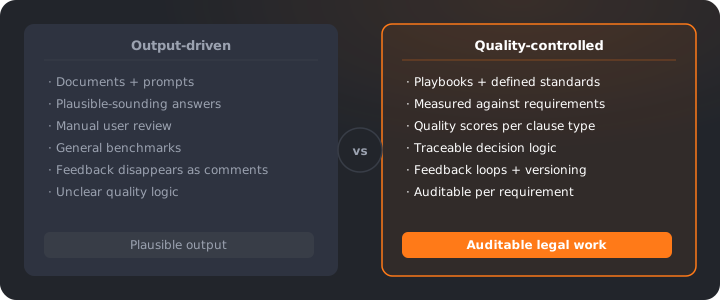
For the Legal AI market, this distinction is fundamental.
Why "Good Answers" Are Not Enough in Legal Work
Generative AI excels at formulating answers, recognising patterns, and presenting content in a linguistically compelling way. But that is precisely where the risk lies.
A legal output can sound highly convincing and still be wrong, incomplete, or misaligned with a company's own standards. For general knowledge work, that is inconvenient. For legal work, it can be business-critical.
Legal teams need to ask different questions:
- Does this assessment align with our internal contract standard?
- Was the relevant clause correctly identified?
- Is the deviation from the playbook visible?
- Is the source or contract provision clearly referenced?
- Is the assessment consistent across similar contracts?
- Can Legal explain why a risk was rated the way it was?
- Is there an audit trail?
- Can quality be measured and improved per requirement?
These questions make one thing clear: Legal AI is not just a productivity tool. Legal AI is becoming part of a company's governance infrastructure.
Three Types of Legal AI: Application, Platform, Model
To make sense of the market, a simple distinction helps.
1. Legal AI as an Application
An application solves a specific legal job — for example, contract review, legal research, contract summarisation, due diligence, or document drafting.
These tools are valuable when they serve a clear use case well. But they are often evaluated primarily on how quickly and convincingly they deliver output.
2. Legal AI as a Platform
A platform provides a technical and organisational layer on which companies can build their own workflows, playbooks, standards, and processes.
The focus here is not on individual answers, but on repeatable legal workflows.
3. Legal AI as a Model
A foundation model with legal context takes a different approach. The premise is that a sufficiently powerful model combined with customer-specific context can replace many traditional software and implementation layers.
This approach is powerful — but also risky. When the model itself is at the centre, governance questions arise immediately: Who controls the quality? Who operationalises legal standards? Who measures whether the AI is correctly applying company standards?
This is precisely where the need for a new category emerges: auditable Legal AI.
What Does Auditable Legal AI Mean?
Auditable Legal AI does not simply mean that a system shows sources or stores a history. That matters, but it is not sufficient.
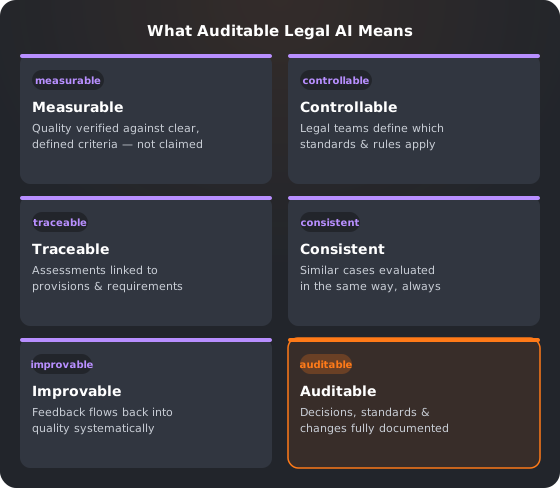
Auditable Legal AI means that legal work is performed by AI in a way that is:
measurable — because quality is not just claimed, but verified against clear criteria;
controllable — because legal teams can define which standards, playbooks, and risk positions apply;
traceable — because assessments remain linked to contract provisions, sources, requirements, or rules;
consistent — because similar cases are evaluated in similar ways;
improvable — because feedback does not disappear as a comment, but flows back systematically into quality;
auditable — because decisions, changes, standards, and assessments are documented.
This shifts the focus from "What can the AI generate?" to "How reliably does the AI operate according to our legal standards?"
The Current Legal AI Landscape: Four Quality Approaches Compared
Many vendors talk about quality today. But they do so in very different ways. Looking at the market reveals four recognisable groups — each with its own quality logic.
Cluster 1: Benchmark-Oriented Performance Vendors
This group relies on structured evaluation: proprietary benchmarks, test sets for complex legal tasks, published scores. The premise is that powerful models demonstrably outperform general alternatives on demanding legal tasks. This is a relevant approach — particularly for law firms and professional legal work.
Cluster 2: Model and Architecture Vendors
A second group positions quality at the system level: multi-model orchestration, legal-grade architecture, technical validation layers. The claim is that the right architecture structurally produces more reliable outputs than generic models. This is also a valid quality story — at the infrastructure level.
Cluster 3: Source-Based Research Solutions
Here, quality is secured primarily through verifiable legal content: statutes, case law, commentaries, curated publisher data. Answers are not freely generated but grounded in traceable legal sources. For legal research, this is a very strong approach. For contract review and legal operations, it alone does not cover all quality requirements.
Cluster 4: Workflow and Playbook Vendors
A fourth group comes closest to the concept of auditable legal work. They talk about playbooks, contract standards, audit trails, traceability, and controlled workflows. Quality logic here arises not just from the model, but from process structure. This is particularly relevant for in-house legal teams.
All four approaches are legitimate. But they are not the same.
Why the Four Clusters Answer Different Quality Questions
A Legal AI solution can publish strong benchmarks without having an operative quality system for customer-specific contract standards.
A Legal AI solution can be built on a powerful architecture without offering requirement-level transparency in an in-house context.
A Legal AI solution can deliver excellent sources for research without measuring contract quality against internal company standards.
A Legal AI solution can structure workflows and playbooks without quantitatively controlling AI quality per requirement.
This is why it matters to look more closely.
Cluster 1: Measuring Performance vs. Operationalising Quality
Benchmark-oriented vendors measure how well Legal AI solves complex legal tasks. This is rigorous and relevant — especially for law firms and professional legal teams who want to know whether a system correctly handles complex legal reasoning.
But the difference from an operative quality system lies here:
Performance evaluation measures how well Legal AI solves legal tasks in general.
Operative quality control measures whether the AI correctly applies specific company standards in repeatable processes.
These vendors rank high on an axis for professional reliability. But not automatically at the top of an axis for measurable, controllable contract quality in an in-house context.
Cluster 2: Architectural Quality vs. Requirement-Level Control
Model and architecture vendors deliver a strong quality story at the technical level. Multi-model orchestration and legal-grade validation are genuine differentiators.
The same applies here: this is different from requirement-level quality assurance in customer-specific contract processes. Architectural reliability is a necessary but not sufficient condition for auditable legal work.
Cluster 3: Source Trust vs. Contract Standard Compliance
Source-based research solutions secure quality primarily through legal content, verifiable references, and curated legal knowledge. This is a very strong approach for legal research.
For contract review and legal operations, source trust alone is not enough. The additional question is whether a system recognises, applies, documents, and systematically improves company-specific contract standards.
Cluster 4: Process Structure vs. Quantitative Quality System
Workflow and playbook vendors come closest to the concept of auditable legal work. Playbooks, audit trails, and traceability are relevant building blocks — especially for in-house legal.
The decisive question remains: is quality only improved through process structure and traceability, or is it quantitatively and systematically measured per requirement?
This is where the differentiation lies — and where a distinct category emerges.
Four Quality Levels of Legal AI
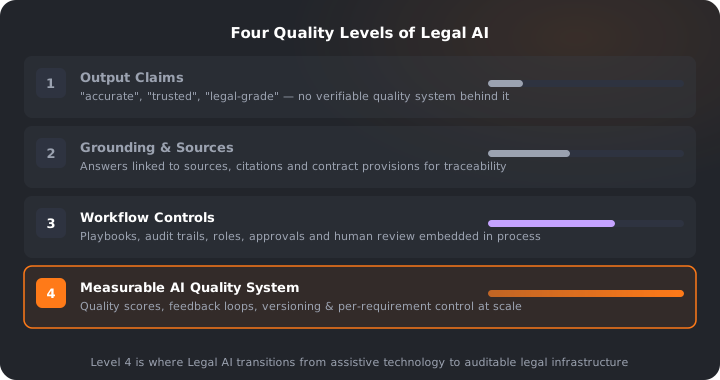
A useful framework distinguishes four levels.
Level 1: Output Claims
At this level, vendors use terms like "accurate", "trusted", "legal-grade", or "high quality". The output is supposed to be good — but the quality assurance remains unclear.
This is the weakest form of quality positioning.
Level 2: Grounding and Sources
Here, answers are linked to sources, citations, contract provisions, or legal data. This improves traceability and reduces the risk of freely formulated statements.
For legal research, this is particularly important. For contract work, it is a foundation — but not yet a complete quality system.
Level 3: Workflow Controls
At this level, playbooks, roles, approvals, audit trails, redlines, standards, human review, and process logic are added.
This is relevant for legal operations and enterprise legal work. The AI is no longer used just as a chat interface, but embedded in working processes.
Level 4: Measurable AI Quality System
The highest level is reached when quality can be measured, controlled, and improved per requirement, playbook, clause type, or contract standard.
This includes, for example:
- Test sets
- Precision, recall, or F1 scores
- Quality scores
- Feedback loops
- Versioning
- Auto-correction
- Transparency per requirement
- Continuous quality improvement
- Traceable assessment against company standards
This is the level at which Legal AI transitions from assistive technology to auditable legal infrastructure.
Why In-House Legal Teams Need a Different Quality Model Than Law Firms
Law firms and in-house legal teams use Legal AI differently.
Law firms typically work in a matter-centric way. They need powerful support for research, analysis, drafting, due diligence, and complex legal argumentation.
In-house legal teams additionally need scalability across the organisation. They must not only apply standards — they must operationalise them.
For in-house legal, the relevant questions are:
- How is an NDA reviewed when Legal cannot look at every document itself?
- How is a procurement contract checked against internal risk standards?
- How does Sales know whether a clause requires escalation?
- How are contract standards kept consistent across teams?
- How can Legal demonstrate that the AI is working reliably?
- How are deviations, unusual clauses, and risks made visible?
This is not just legal expertise. This is legal governance.
In-house legal therefore needs a different category of Legal AI: not just assistants for lawyers, but systems that translate legal standards into repeatable operational logic.
Legartis' Position: From Contract Review to Auditable Legal Work
Legartis occupies a clear position in this market logic:
Legartis is not simply a Legal AI assistant. Legartis is a Legal AI Workspace that translates legal standards into measurable, controllable, and auditable contract work.
This is a different claim from "review faster" or "generate better answers".
Legartis sits at the point where generative AI becomes controlled legal execution:
- playbook-based
- standardised
- quality-measured
- workflow-integrated
- traceable
- scalable for in-house legal, compliance, and business teams
The core differentiator is not that Legartis has a better foundation model than others. That would be the wrong battleground.
The stronger statement is:
Foundation models make legal work more accessible. Legartis makes it reliable, controllable, and scalable across the enterprise.
This positions Legartis in the layer between foundation model and legal decision.
The Critical Distinction: Measuring Performance or Operationalising Quality
The market talks a great deal about AI evaluation. That is important. But companies need to look more closely.
There is a difference between:
"How well does the model perform on legal tasks?"
and
"How reliably does the AI apply our specific contract standard in this process?"
The first is performance evaluation.
The second is operative quality control.
For legal teams, the second question is often more decisive. A company does not buy Legal AI just to produce impressive outputs. It buys Legal AI to make work safer, faster, more consistent, and more scalable.
For that, quality must be measurable where legal work actually happens: in the contract, in the clause, in the playbook, in the requirement, in the workflow.
A New Matrix for Legal AI
To meaningfully position Legal AI platforms, the classic distinction between law firms and in-house legal is not sufficient. Nor is "assistive AI" versus "auditable AI" entirely clean, since almost all Legal AI systems are assistive in some way.
A stronger matrix would be:
Y-axis: Controllable AI Quality versus Plausible AI Output
X-axis: Law Firms & Legal Professionals versus In-House Legal, Compliance & Business Teams
This matrix produces four categories.
1. Trusted Legal AI for Lawyers
Solutions in this category focus strongly on legal research, drafting, due diligence, and professional legal work for law firms and legal practitioners. This includes benchmark-oriented vendors and source-based research solutions that rely on verified legal content.
2. AI Legal Assistance
Tools here accelerate legal work, but their quality depends heavily on user review, prompting, or manual oversight. They are useful, but less strong when it comes to auditable quality control.
3. Contract Workflow Automation
Solutions here — including many workflow and playbook vendors — structure contract processes, map workflows, and support teams, but do not necessarily have a measurable AI quality system per requirement.
4. Auditable Legal Work for the Enterprise
This is the category becoming most relevant for in-house legal: Legal AI that translates company standards into measurable, controllable contract work. This is the category Legartis can own.

Why "Auditable" Cannot Be a Marketing Word
The term auditable is becoming attractive across the Legal AI market. But if every vendor uses it, it loses meaning.
That is why auditable Legal AI must be defined precisely.
Auditable does not simply mean:
- there are sources,
- there is a log,
- there is a chat history,
- there is an export,
- there are security certifications.
All of that matters. But auditable AI quality means more.
It means a company can show:
- which rule was applied,
- which requirement was affected,
- which contract provision was reviewed,
- whether the AI was correct,
- how reliably the system performs on this requirement,
- when the rule was changed,
- how feedback was processed,
- what quality the current version achieves.
That is the difference between documentation and quality control.
The Next Buying Decision: Who Controls the Quality?
For legal teams, the central buying decision will no longer be simply: "Which Legal AI is the most powerful?"
But rather:
Which Legal AI can we be accountable for?
This gives rise to new evaluation criteria for legal teams:
- Are there measurable quality metrics?
- Is quality claimed per use case — or only in general terms?
- Can the AI be tested against your own standards?
- Are there playbooks and requirement-level transparency?
- Are there feedback loops?
- Can Legal identify unusual clauses and escalate them?
- Are results traceable?
- Is quality versioned?
- Can business teams work with the system safely?
- Does Legal remain in control?
These criteria become especially important when Legal AI is used not only by lawyers, but also by procurement, sales, compliance, and other business teams.
Conclusion: The Future of Legal AI Is Not Just Generative — It Is Controllable
Legal AI has moved past its first phase. The question is no longer whether AI can support legal work. The question is which kind of Legal AI companies actually need.
For basic productivity, output-driven AI is sufficient.
For research, good sources are required.
For professional legal work, powerful models and robust evaluation are necessary.
For scaled contract work across the enterprise, more is needed: measurable, controllable, and auditable AI quality.
This is precisely where the next strategic differentiation in the Legal AI market is forming.
The decisive statement is:
Many Legal AI vendors improve output quality through sources, benchmarks, architecture, or workflow controls. Legartis goes further: quality is made measurable, controllable, and auditable per legal requirement.
This is more than a product promise. It is a new category.
Legal AI must not only sound plausible. It must work accountably.
→ Download the Legal AI Guide 2026 and see how auditable Legal AI works in practice.
FAQ
Frequently asked questions
Auditable Legal AI refers to AI systems for legal work whose outputs are traceable, measurable, controllable, and verifiable. Unlike purely generative Legal AI, auditable Legal AI evaluates outputs against defined standards, playbooks, or requirements — and makes quality systematically visible.
Generative AI can produce legal answers, summaries, or contract comments. For legal teams, that is not sufficient — because legal work must be consistent, traceable, and accountable. Companies need to know whether an output aligns with their own contract standards, not just whether it sounds plausible.
A Legal AI playbook is a structured rule set that defines which clause types are reviewed, which risk standards apply, and which deviations require escalation. It translates a company’s legal standards into machine-readable review logic that an AI can apply consistently and traceably.
Auditable Legal AI is most relevant for legal departments, compliance teams, and legal operations functions in companies that need to scale contract work. Unlike law firms, in-house legal teams need not just powerful outputs, but repeatable processes, traceable decisions, and the ability to account for AI quality internally.
Legartis is a Legal AI Workspace built for auditable contract work. The differentiator is not the foundation model — it is the quality and control layer: playbooks, requirements, quality scores, feedback loops, and traceable workflows make AI outputs measurable and controllable, while legal teams remain in control.
Legal AI evaluation measures how well a model or system solves legal tasks. An AI quality system operationalises quality within specific workflows — per contract standard, clause type, or playbook requirement. Evaluation measures performance; a quality system governs repeatable legal work.
Legartis measures AI quality at the requirement level: for each clause type, playbook standard, or contract requirement, outputs are compared against defined review rules. Quality scores, feedback loops, and versioning make it visible how reliably the system applies specific company standards — and enable targeted improvement.
Explore Related Insights
More articles related to this topic


Start with Legartis Today!
Talk to us about your business case or test Legartis right away!