
Will AI Replace Lawyers? 7 Tasks AI Takes Over, 3 That Stay
Table of contents
Whether AI will replace lawyers has no simple yes or no. What is clear is that the division of work is shifting: from the lawyer to the AI agent, and from the legal department to the business. Here is which tasks agents can take over, which stay with lawyers, how legal teams keep control, and why they need people who can check.
AI will take over a substantial share of the work lawyers do today. Whether that leads to fewer legal jobs remains an open question, depending on how law firms and companies use the productivity gains. What is clear is that the way legal work is divided is changing fundamentally.
Business teams such as sales, procurement and HR will increasingly handle contracts, legal questions and approvals themselves, with AI agents running the workflows according to Legal's standards. Lawyers define the boundaries within which AI can operate, assess risks and oversee the quality of its output. Responsibility remains with people, both under professional rules and within the organisation.

But this new role raises a difficult question. If AI takes over the routine work through which junior lawyers traditionally develop their judgement, who will have the expertise to oversee the AI? We have summarised what seven studies and guidelines say about this in a free compact guide.
Jump to the seven tasks in detail
Legal Work Is Moving from Legal to the Business
Much of the work that reaches Legal gets there because only Legal knows the standard and how to apply it. Sales asks whether it can accept a customer's liability cap, procurement which template applies to a new supplier. The answer usually sits in a guideline nobody outside Legal reads, so the question waits for a lawyer, or the business finds a way around Legal.
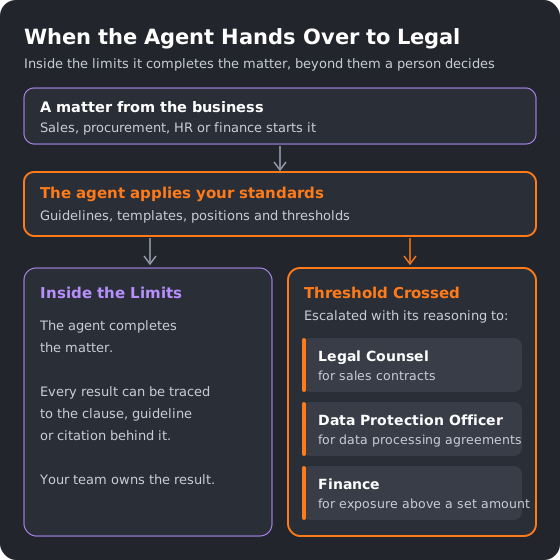
An AI agent changes who can apply that answer. Once Legal's guidelines, templates and thresholds are written down, every business team, from sales and procurement to finance and HR, can work through defined legal matters itself and get a result straight away: a report, a template or a revised document. If a matter crosses a threshold, it is escalated to Legal with an explanation, and Legal decides which topics still come to a lawyer at all.
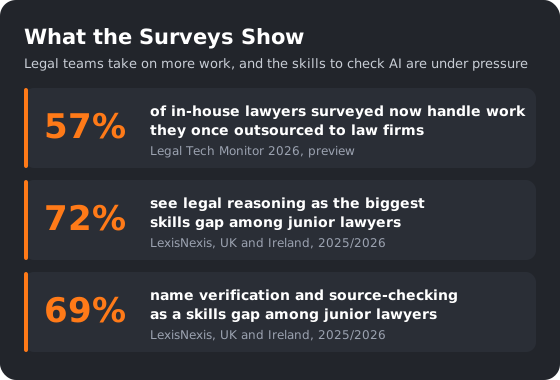
Work is also moving between companies and their law firms. In a preview of the Legal Tech Monitor 2026 of the German Legal Tech Verband, 57% of in-house lawyers surveyed said they now handle themselves what they would have outsourced to law firms two or three years ago, as Deutscher AnwaltSpiegel reported. The figure does not say why. AI can make it easier to keep work in house, but plenty stays external, routine work included: for capacity, specialist knowledge, regulatory requirements or an outside opinion to back a decision.
For junior lawyers, this is the delicate part. AI first takes over the tasks on which they learn the job: research, first drafts and document review. Productivity gains may therefore mean fewer entry-level roles, even though responsibility stays with people. Whether that happens is up to law firms and companies. Fewer people doing the work does not mean less accountability for it. The ethics guidelines of the New York State Bar Association, published on 31 October 2026, state that attorneys remain responsible for supervising work done by people who are not lawyers and for ensuring it meets their standards, "even if the 'non-lawyer' is an AI tool or system". The guidelines also explicitly cover reviewing the output of agentic AI systems.
Three Tasks for Which Lawyers Are Still Needed
In our division of the work, three tasks stay with lawyers. They are the reason a company employs lawyers in the first place.
1. Deciding on Risks Outside the Agreed Limits
When a deviation goes beyond the limits Legal has set, someone has to decide whether the company accepts the risk. Whoever decides weighs the clause against the deal, the counterparty and the commercial pressure. An agent can describe the deviation precisely, but it cannot carry the accountability for accepting it. Models also tend to flag every conceivable risk without weighing how large or how likely it is, and that assessment calls for legal judgement.
2. Setting the Standards
An agent works to your playbook, so someone has to write it: which positions are acceptable, which fallback positions exist, where the thresholds sit and who owns each one. This is where a lawyer's judgement has the greatest reach, because a position written once applies to every matter the agent handles afterwards. Standards also age as the law, the business and the negotiations change. Keeping them current is ongoing legal work.
3. Advising Where Nothing Is Written Down
Some of the most valuable legal work has no template: a new business model, an escalating dispute, a letter from a regulator. Here the lawyer is not applying a standard. They are forming one, often in a conversation, with incomplete information and a business that needs an answer by Friday. This is exactly the work that gets squeezed when the inbox is full.
The Paradox: Who Checks the AI When Nobody Learns the Work Anymore?
The more reliably an agent runs a workflow, the more a company needs people who can still tell when it is wrong.
The more legal work AI agents handle across the business, the more important it becomes for Legal to oversee the quality of that work. All three tasks that stay rest on one assumption: that a lawyer can still tell when the agent is wrong. At the same time, part of the experience that ability rests on is disappearing. Checking a contract review competently takes sound legal expertise, and lawyers have always learned that expertise by doing the work themselves.
The problem is older than AI. In 1983, the psychologist Lisanne Bainbridge described what happens when machines run a process and people supervise it from a control room in "Ironies of Automation". Her point was simple: the skills you need to take over from a machine fade when the machine does the work, and the people who never did the work never had them. Her conclusion follows from it: "Perhaps the final irony is that it is the most successful automated systems, with rare need for manual intervention, which may need the greatest investment in human operator training." Such systems are "riding on their skills, which later generations of operators cannot be expected to have."
Replace the control room with a legal department, and the argument holds. The lawyers who check AI output today trained their judgement on hundreds of contracts they read themselves; the next generation will not get that practice by default.
Whether, and how far, AI erodes legal judgement over time has hardly been studied yet. Recent surveys and studies show that the concern has reached practice.
In a LexisNexis survey of legal professionals in the UK and Ireland, run in December 2025 and January 2026, 72% saw deep legal reasoning and argumentation as the biggest skills gap among junior lawyers, and 69% named verification and source-checking. In October 2026, the Law Society of England and Wales published a practice note on AI, and its president, Brett Dixon, warned that "overreliance on AI systems may result in a catastrophic gap of future legal skills and knowledge."
A Microsoft Research and Carnegie Mellon survey of 319 knowledge workers found that "higher confidence in GenAI is associated with less critical thinking, while higher self-confidence is associated with more critical thinking." Citing Bainbridge, the authors name the risk: automating routine tasks while leaving the exceptions to people can "deprive the user of the routine opportunities to practice their judgement". A smaller MIT Media Lab study with 54 participants, not yet peer reviewed, found that most of those who wrote their essay with ChatGPT could not correctly quote a single sentence from it minutes later. None of these studies proves the long-term effect on legal skills: the MIT study concerns essays rather than legal work, and the surveys rely on what respondents report. Bainbridge explains the mechanism; the newer data shows it is current.
Legal Judgement Comes from Experience
Children still learn to write, even though most of them will dictate to a machine one day. Nobody thinks that is wasted effort, because writing does not mainly teach them to produce text. It teaches them to shape a thought until it fits into words, and with it the language they later use to think, to order the world and to understand each other.
For lawyers the point is sharper still, because language is not their tool but their subject matter. Laws, contracts and guidelines are made of text, and an inconspicuous "including" can help decide whether a list is meant to be exhaustive. A lawyer who has drafted, negotiated and defended such clauses sees it at once. A lawyer who has never done so reads the agent's draft and finds it plausible.
How Legal Teams Stay in Control of AI Agents
The answer has two parts: workflows that can be controlled, and people who can control them. For the first part, three conditions govern when an AI agent may handle a matter on its own:
- Clear, documented standards. Guidelines, templates and positions describe what a good result looks like, so the agent applies your rules, not its own judgement.
- Results that can be traced to a source. Every result can be traced back to the relevant clause, guideline or citation.
- Escalation thresholds that define when a person decides, and who. Legal sets the limits within which decisions may be taken. Inside those limits, the agent completes defined matters. Beyond them, it hands the matter to the named owner with its reasoning.
Typical thresholds are a liability cap above your approved amount, governing law outside your accepted list, or a data transfer your guidelines do not cover. Each threshold has a clearly defined owner: the Legal Counsel for sales contracts, the Data Protection Officer for data processing agreements, Finance for exposure above a set amount. The owner sees which limit was crossed and why, and decides that point without reconstructing the whole matter. A person makes the decision, and your team owns it.
These conditions are necessary but not sufficient. A citation is no guarantee of quality: an agent can source every statement correctly and still miss a clause, because completeness is not the same as a correct reference. Not every business team may see every contract, so roles and permissions have to protect confidentiality. And quality has to be validated before go-live and monitored afterwards. What matters is how a provider implements these requirements for legal workflows. In the Legartis Legal Agent, every result is traceable to its source, quality is measurable for each requirement, and a complete audit trail records what happened.
Who turns legal expertise into workflows that can be controlled? Some teams call this role the legal engineer: someone who describes positions, thresholds and responsibilities so that an agent can execute them, and tests whether it applies them correctly. It can be part of a lawyer's job or a role of its own. With the Legal Agent, much of it happens in plain language: you describe a process once, written or spoken, and recurring steps can then be saved as Frequent Actions.
The other half of the answer concerns the people who will do the checking. For a legal team, that means three deliberate decisions:
- Build manual work into the learning path. Junior lawyers handle part of the matters themselves first, then compare their result with the agent's. The difference is the lesson.
- Turn escalations into training. Every matter the agent escalates beyond a defined threshold is a real decision with real risk. Junior lawyers prepare it, and experienced lawyers explain the decision.
- Write knowledge into the standard. When experienced lawyers record their positions as guidelines, playbooks and thresholds, their reasoning becomes accessible to others and usable for the agent.
None of this argues against agents. It is what makes them trustworthy. The more reliably an agent runs a workflow, the more a company needs people who can still tell when it is wrong. An agent that shows the source and the requirement behind every result makes targeted checking easier. It does not make the people who check redundant.
How such a boundary works in a complete process, and what liability and the EU AI Act mean for it, is covered in our article on AI agents in the legal department. What a General Counsel must be able to prove once agents run matters is the subject of governing agentic legal AI.
Seven Tasks AI Agents Can Take Over
In many legal teams, these seven tasks come closest to meeting all three conditions, and how far the agent goes differs from task to task. For the mechanics of each agent, see our article on seven AI agents that take work off legal teams.
1. Sorting Incoming Legal Requests
The legal inbox often belongs to nobody in particular. Matters arrive without context, and paralegals or legal assistants often spend part of every day working out what each one is and who should handle it. At intake, the Legal Agent recognises the department, the document type and the playbook that applies, prepares the matter and passes it to the person who decides. That is as far as it goes here: it sorts and prepares, and you decide who owns what.
2. Pre-Reviewing Contracts and Spotting Deviations
Without a first pass, a lawyer reads every incoming contract in full before anyone knows whether it contains any issues. When procurement submits a supplier agreement, the agent can check it against your positions while it is still with the business and show each deviation with the passage and the requirement side by side. It pre-reviews but does not decide. If a deviation crosses a threshold, the contract reaches you, and you read the clauses that deviate rather than every page.
3. Drafting from Your Templates
In many cases Legal no longer needs to draft at all. Sales generates the framework agreement from your template, with the clause variant your playbook allows for this customer. The Legal Agent returns it as a Word document in your layout, ready to go out without anyone reformatting it. Its limit is the template: new business models, unusual structures and contracts where every clause is a negotiating decision are still drafted by you.
4. Taking a Matter Through to Signature
Much of a matter's life is coordination: approvals, versions, the counterparty's latest changes. The Legal Agent can draft from your template, coordinate approvals, manage negotiation rounds and take the contract through to signature. It coordinates but approves nothing. A person grants each approval, and you decide on concessions in the negotiation.
5. Answering Recurring Questions from the Business
HR asks whether a clause in a contractor agreement is standard. Marketing wants to know whether a partnership agreement contains the clauses your guidelines require. When an internal guideline covers the answer, business teams can get it directly from the Legal Agent, each in its own Focus Space, which runs on your guidelines and templates. The agent answers what your guidelines cover. Anything else, such as a delicate competition-law question about an advertising campaign, still comes to you.
6. Legal Research and Matter Preparation
Before a lawyer gives an opinion, someone has to find the relevant provisions, earlier decisions, the internal guideline and the clause in the framework agreement. The agent can do that groundwork, with every result traceable to its source. You still check whether the sources are complete and current, because a correctly cited result can leave out a relevant authority. The opinion itself remains your work.
7. Reporting on the Contract Portfolio
What liability exposure exists across your active contracts? How many have no cap, and which ones expire soon? In the Legartis workspace, Contract Insights answers these questions: it is the Legal Agent working across the whole portfolio on a schedule or when an event occurs, and filing the result as a report. You define once which questions a report answers. What the numbers mean for the business, and which exposure is acceptable, is for Legal to judge.
In all seven, the line runs through the task, not between tasks: the agent applies rules someone has already set and stops where they end. If you want to see which of these tasks the Legal Agent could take over in your team, book a demo.
Does AI Really Save Time Once You Count the Checking?
Only if the way you review AI output changes. If a lawyer re-reads every output in full, the time saved is small or even nil.
Two things change the calculation. First, every output shows what it is based on, so checking means verifying a cited passage rather than re-reading a document. Second, quality is measurable for each requirement, so you know which checks the agent reliably gets right and where your review should focus. Our AI Quality page shows how Legartis measures it. How much time you actually gain therefore depends less on the agent's speed than on its reliability, and on someone knowing what a good result looks like.
Conclusion: Less Routine Work, More Legal Judgement
AI is taking over much of the work lawyers currently do themselves, from preparing drafts and pre-reviewing contracts to coordinating legal workflows. As business teams handle more of these tasks through AI agents, Legal's role shifts from processing individual matters to defining the rules, assessing risks and overseeing quality.
That shift depends on something automation cannot provide on its own: people with the expertise to recognise when an AI agent gets it wrong. Developing that expertise has to remain a deliberate part of legal training.
Legartis is built for this new division of work. Its Legal Agent runs legal workflows according to Legal's standards, inside an agentic legal workspace for Legal and every business team, with defined escalation points and results traceable to their sources. Legal stays in control of the decisions that matter.
We have summarised the seven studies and guidelines cited here in a free compact guide, Strengthening Legal Expertise in the Age of AI, with a concrete recommendation for each source. Or book a demo to see how AI agents can work to your standards and when they hand decisions back to Legal.
FAQ
Frequently asked questions
AI takes over a large share of the tasks lawyers do today: sorting incoming matters, pre-reviewing contracts, drafting from templates, collecting approvals, answering recurring questions from the business, research and reporting. Responsibility stays with people, both under professional rules and inside the company. Whether this means fewer legal jobs is open and depends on how law firms and companies use the productivity gains. What is certain is that the division of work shifts: business teams handle defined matters themselves, while Legal sets the standard, decides on risks outside the agreed limits and advises where nothing is written down.
AI takes over many of the tasks on which junior lawyers have traditionally learned, such as research, first drafts and document review. That may mean fewer entry-level roles, even though responsibility stays with people. At the same time, someone has to check what the agents deliver, and that takes sound legal expertise. In a LexisNexis survey of legal professionals in the UK and Ireland, 72% saw deep legal reasoning and argumentation as the biggest skills gap among junior lawyers. Legal teams can respond deliberately: juniors handle some matters themselves first and prepare the decisions the agent hands over.
Their tasks are among the first an agent takes over, because much of their work follows fixed rules: sorting incoming documents, preparing files, filling templates, tracking approvals and versions. The role does not disappear by default, but it changes. Someone has to maintain templates, check what the agent prepares and keep the workflow running, which comes close to what a legal engineer does.
A legal engineer translates how a legal team works into something an AI agent can execute: written guidelines, templates, thresholds, routing rules and the tests that show whether the agent applies them correctly. The role combines legal judgement, process thinking and enough technical fluency to test an agent. In-house, it can be part of a counsel's or a Legal Operations job, or a position of its own.
In our division of the work, three remain with lawyers. They decide on risks that go beyond the limits Legal has set. They set and maintain the standard the agent works to: positions, fallback positions, thresholds and owners. And they advise where nothing is written down, such as new business models, disputes, regulatory enquiries or board decisions. An agent can prepare all three, but it cannot carry the judgement or the responsibility.
Internally, that is a question of organisation: every threshold needs a named owner who decides beyond the agreed limits, and the company has to define who checks the agent's results. Legal liability is a separate question. It depends on the jurisdiction, the contracts, organisational duties and the specific breach, and there is no general rule. For attorneys in New York, the NYSBA guidelines state that they answer for AI-assisted work as they do for work by people who are not lawyers. More on the boundary in AI agents in the legal department.
Explore Related Insights
More articles related to this topic



Start with Legartis Today!
Talk to us about your business case or test Legartis right away!