
Prompts for Lawyers: How to Get Reliable Results from Any AI Model
Table of contents
Most legal teams use several AI tools at once. This guide shows how to write prompts that get reliable results from all of them, and how to check whether the answer is right.
Most legal teams do not work with one AI tool. They work with several. Microsoft Copilot runs in the existing Microsoft 365 environment, one colleague uses ChatGPT, another uses Claude, and IT is testing a European model on the side. So the useful question is not which tool is best. It is how to write prompts that get good results from all of them.
This guide gives you the anatomy of a legal prompt, ten prompts that work regardless of the model, a method for checking the answers and a clear line on which data can go into which system.
What Makes a Good Legal Prompt?
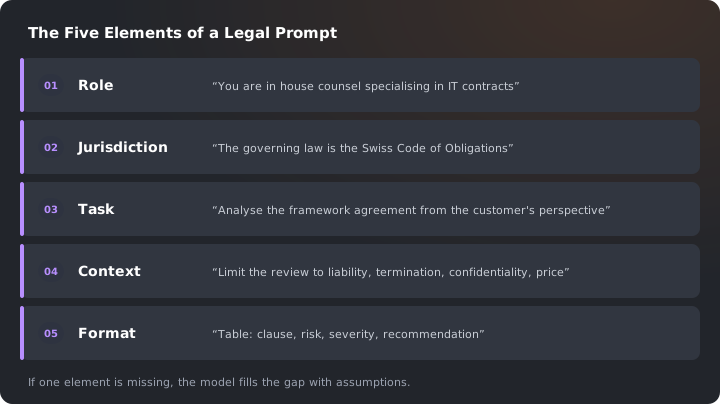
A prompt is an instruction. The vaguer the instruction, the less useful the result, exactly as with a trainee. Five elements make the difference.
- Role: who should answer? "You are in house counsel specialising in IT contracts" produces different vocabulary and a different level of detail than a question without context.
- Jurisdiction: without one, models tend to answer under US law, because that is where most of their training data comes from. State the governing law: the Swiss Code of Obligations, the German Civil Code, English law.
- Task: one precise verb for one clean result: analyse, compare, draft, identify risks, translate. "Have a look at this" is not a task.
- Context: contract type, industry, negotiating position, history so far. The more of it the prompt contains, the less the model has to guess.
- Output format: a table with defined columns, a numbered list, a maximum number of sentences. A fixed format forces precision and prevents evasive prose.
Before
"Review this contract."
After
"You are in house counsel specialising in IT contracts. The governing law is the Swiss Code of Obligations. Analyse the attached framework agreement from the customer's perspective. Return a table with the columns: clause, risk, severity (high/medium/low), recommendation. Limit the review to liability, termination, confidentiality and price adjustment."
Which Model for Which Legal Task?
What matters is how a model is built, not what it is called. Four categories cover legal practice, and the mapping holds even when a new version comes out next week.
Reasoning models take longer before they answer and work through the task in intermediate steps. Use them for multi step analysis where the chain of argument matters.
Models with a large context window process entire contracts, schedules included, in one pass. They are the right choice when you need to compare across hundreds of pages instead of copying clause by clause.
European models usually run in Europe and are subject to European data protection law. Where server location rules out other options, they are often the only choice.
Assistants built into Microsoft 365 sit where your documents already are. They save the upload and download, but tend to go less deep in pure analysis.
One expectation to set: none of these models has been trained on your company's standards. None of them knows your fallback positions or your risk thresholds. The last section comes back to this.
If you work mainly with ChatGPT, you will find ready to use prompts and tips in ChatGPT for lawyers.
Ten Prompts That Work with Any Model
None of these prompts depends on a particular product. Copy them and replace the details in square brackets.
Prompt 1: Find Deadlines and Automatic Renewals
"Search the attached contract for all deadlines: term, notice periods, automatic renewals, options. Return a table with the columns: clause, type of deadline, duration, triggering event, consequence if missed. Flag automatic renewals separately."
Missed renewal deadlines are among the most common mistakes in contract work. This prompt finds them in minutes rather than another read through.
Prompt 2: Test Several Contracts Against One Question
"I am attaching [number] contracts. For each one, check how liability is limited. Return a comparison table: contract, liability cap, exclusions, deviation from market standard. End by naming the contract with the highest risk and give a short reason."
This finds the outliers in your portfolio without opening every contract.
Prompt 3: Research with Mandatory Sources
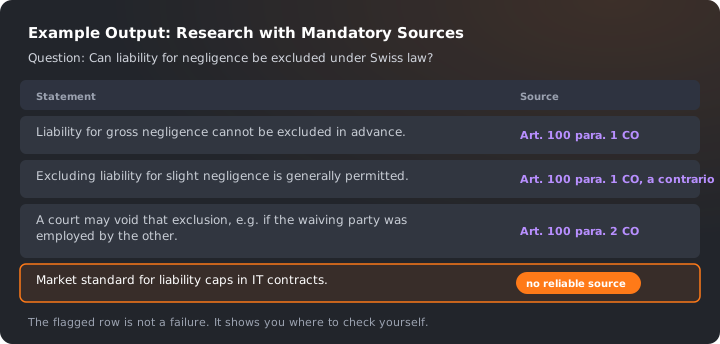
"Answer the following question under [jurisdiction]. Cite the specific provision or decision for every statement. If you have no reliable source, write 'no reliable source' instead of filling the gap. Question: [question]."
The second sentence does the work. It turns a weakness of the model into information you can use.
Prompt 4: Anonymise Before Uploading
"Replace all names, companies, addresses, amounts and dates in the following text with neutral placeholders such as [Party A], [Amount 1], [Date 1]. Return a mapping list so I can reverse the placeholders later. Change nothing else."
A practical step before text goes into a system that is not approved for confidential data. Anonymise in an approved system or by hand, never in the model that is not allowed to see the original.
Prompt 5: A Risk Matrix Instead of Prose
"Assess the risks in the attached contract from the perspective of the [customer/supplier]. Place each risk in a matrix of likelihood (high/medium/low) and impact (high/medium/low). Name the relevant clause for each entry."
The matrix forces you to prioritise. A list becomes a basis for a decision.
Prompt 6: Stress Test an Argument
"Check the following legal argument for gaps: which premise is unsupported? Where does the chain break? Which counterargument is the most dangerous? Answer in three sections. Argument: [text]."
You do not get a new opinion. You get a stress test for your own.
Prompt 7: Turn a Provision into a Checklist
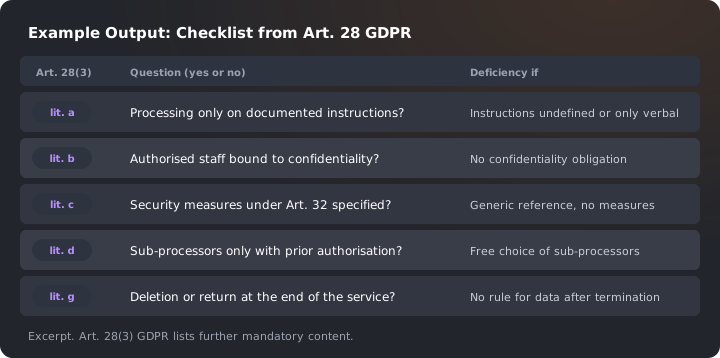
"Derive a review checklist from [provision, for example Art. 28 GDPR]. One item per mandatory requirement, each phrased as a yes or no question. For each item, add how to recognise a deficiency."
A provision becomes a tool that colleagues without specialist knowledge can use.
Prompt 8: Record the State of a Negotiation
"Summarise the attached email thread as a negotiation record: who took which position and when, what is agreed, what is open, which next step was agreed. No assessment, only a record."
Especially useful when a matter is handed over or comes back after months.
Prompt 9: Translate Across Legal Systems
"Translate the following clause into [target language] and flag every term that carries a different meaning in the target legal system. For each flagged term, propose wording that preserves the original purpose of the clause."
A literal translation is not enough for contracts. This prompt shows where the meaning breaks.
Prompt 10: Let the Model Improve Your Prompt
"Assess the following prompt: what is unclear, what is missing, where is it too open? Return a revised version and explain the changes. Prompt: [your prompt]."
The fastest way to get better without taking a course.
How to Check Whether the Answer Is Right
Most prompt guides stop at the prompt. Whether you can use the result depends on how you check it.
Ask for sources and spot check them. If a provision is cited, open it. Invented citations show up on the first click.
Make uncertainty visible. Telling the model to write "no reliable source" where it has none gives you a map of the weak spots.
Check against the original. For contract analysis, always ask for the clause and page number. Checking then takes seconds instead of minutes.
Let the model attack its own analysis. A second pass that asks for gaps and alternative readings surfaces something surprisingly often.
Ask twice, with two models. If two systems reach the same result independently, that is an indication. If they differ, you know where to look yourself.
From Individual Prompts to a Team Standard
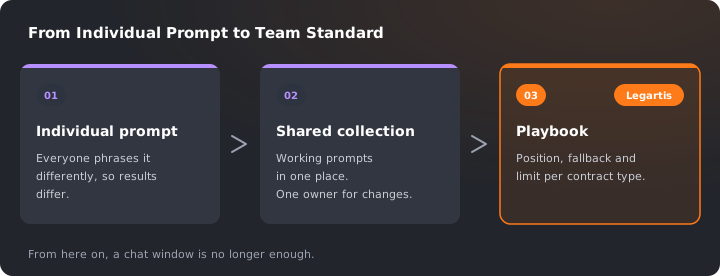
A good prompt is an individual achievement. A good standard is an organisational one. The difference shows as soon as several people review the same type of contract: each phrases the prompt differently, so each gets a different result. In legal work that is the problem, because consistency is the precondition for comparability and for proof.
Three steps help. First, collect the prompts that work in one place instead of in private notes. Second, record for each contract type which position you prefer, what you accept and where the limit is. Third, decide who may change a prompt, so that not everyone maintains their own version.
By the second step at the latest, you are no longer writing prompts. You are writing a playbook. And once that playbook should run automatically against every incoming contract, a chat window is no longer enough.
Which Data Can Go into Which Model?
Many teams only ask this once someone has already started. Three points settle most of it.
Consumer or enterprise. In free consumer versions, inputs can be used to improve the models. Enterprise agreements with a data processing agreement exclude that. Clarify this internally first. The answer usually sits with IT, not in the product.
Server location. Even with a signed data processing agreement, where the data is processed still matters. For many legal teams in Switzerland, Germany and Austria, processing in Switzerland or the EU is the deciding criterion.
Professional secrecy and confidentiality. Lawyers are bound by professional secrecy. In house counsel are too in some jurisdictions, and otherwise bound by contractual confidentiality. Both apply to what you enter into a language model. Where client or personal data is involved, you need a documented confidentiality framework. The anonymisation prompt above is a bridge, not a substitute.
In practice: for structuring, research on published case law and drafting without real data, you can work freely. As soon as real contract text, internal positions or customer data are involved, the compliance set up of the system decides, not the quality of the prompt.
Where Prompting Reaches Its Limits
Prompting makes you faster. It does not make a review reproducible. Give the same contract to the same model twice and you get two similar, but not identical, answers. For research that is fine. For a contract review that has to stand up in a dispute, it is not.
Contract review is not a language problem. It is a question of structure, risk and consistency. A general language model cannot reliably decide whether a clause meets your internal guidelines or whether a particular limitation of liability is acceptable for your company. It does not know your fallback positions, your negotiation history or your risk thresholds.
This is where a Legal AI Workspace comes in. Instead of free prompts, it works with legally validated requirements: your standards sit in a playbook, every incoming contract runs against the same rules, and every flagged clause can be traced back to a rule.
AI contract review checks against your requirements instead of generic patterns. The Contract Playbook Creator builds a playbook in minutes, or in two to four hours with many templates, instead of weeks of alignment. The Legal Agent answers everyday legal questions, connected to your company's knowledge. And AI quality measurement shows how reliably the AI detects each requirement.
None of this replaces prompting. For drafts, a change of perspective and research, the prompts above stay useful. For a systematic review against your own standards, you need a system that knows those standards.
FAQ: Prompts for Lawyers
What Makes a Good Prompt for Lawyers?
A good legal prompt contains five things: the role to answer from, the governing law, a precise task with a clear verb, the necessary context and a fixed output format. If one is missing, the model fills the gap with assumptions.
Do the Same Prompts Work with Every Model?
Largely, yes. A prompt with role, jurisdiction, task, context and format produces usable results with all common systems. Differences show mainly in how long a document the model can process and how deep it goes in multi step analysis.
Which AI Model Is Best for Legal Questions?
It depends on the task. Reasoning models suit multi step analysis, models with a large context window suit long contracts, and European providers suit strict data protection requirements. None of them knows your internal standards.
Can I Upload Contracts to an AI Model?
That depends on the version and on your internal approval. In free consumer versions, inputs can be used to improve the model. With an enterprise agreement and a data processing agreement, the position is different. Clarify it with IT before the first upload.
How Can I Tell Whether an AI Answer Is Wrong?
Ask for a source for every statement and spot check them. Have the model state explicitly where it has no reliable basis. For contract analysis, always ask for the clause and page number so you can check against the original.
Does Prompting Replace Specialised Legal AI?
No. Prompting speeds up individual tasks, but it does not produce reproducible results and does not know your standards. A systematic contract review against your own playbook needs a system that holds those rules.
How Do I Turn Good Prompts into a Team Standard?
Collect working prompts in one place, record for each contract type your preferred position, your acceptable compromise and your limit, and decide who may change a prompt. That is the foundation of a playbook.
The Next Step
Prompting pays off immediately, whichever model your company has approved. You can use the ten prompts above today, and the checking method too.
Once individual requests turn into a recurring process, the question changes. It is no longer how you phrase a prompt. It is whether your whole team works to the same rules, and whether you can prove it when it counts.
Explore Related Insights
More articles related to this topic



Start with Legartis Today!
Talk to us about your business case or test Legartis right away!