
Implementing Contract Management Software: A 2026 CLM Guide for Legal and Sales
Table of contents
Contracts are the foundation of every business relationship. Yet in most large organizations, contract management is organized chaos. Contract management software is supposed to fix that — and regularly fails. Not because of the technology, but because of what should have been resolved before the implementation ever started.
Why Contract Management Software Only Works When Both Sides Are Ready
Contracts are the foundation of every business relationship. Yet in most large organizations, contract management is organized chaos: NDAs circulating by email, customer agreements bouncing between sales and legal as Word attachments, approvals disappearing into inboxes, renewal clauses that nobody tracks. Contract management software is supposed to fix that — and regularly fails. Not because of the technology, but because of what should have been resolved before the implementation ever started.
67% of in-house lawyers say they are drowning in low-value work — reviewing standard contracts, redlining clauses, answering the same questions over and over (Juro, 2024 State of In-house Survey). At the same time, demand keeps growing: 83% of legal departments expect volume to increase while resources remain flat (CLOC, State of the Industry 2025).
Contract Lifecycle Management (CLM) promises the answer. And the technology has genuinely matured: AI-powered clause analysis, automated approval and workflow management, integrated e-signature, real-time contract data. What was once the domain of niche vendors is now broad market standard.
This guide explains why CLM projects in large organizations still fail — and how legal and sales teams can approach an implementation together in a way that outlasts the rollout.
Why CLM Projects Fail — and Why Nobody Admits It
Post-mortems on failed CLM implementations read with striking consistency. Rarely do they say: "The system was wrong." More often: "Adoption rates were too low." "Data quality didn't meet expectations." "Sales went back to the old method."
These are not technology problems. They are organizational problems.
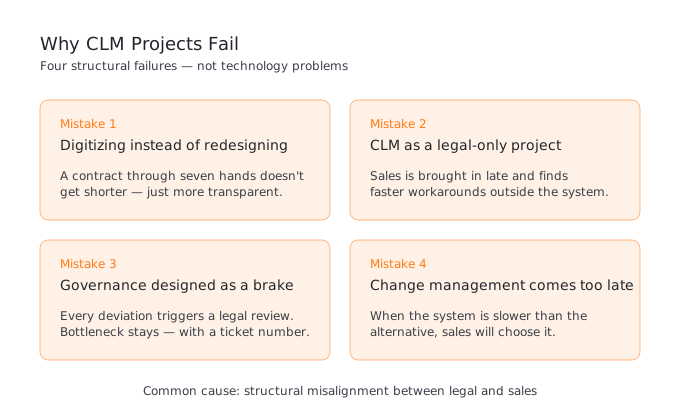
Four structural failures — not technology problems.
Mistake 1: Existing processes are digitized, not redesigned. The most common trap: a company maps its current workflows 1:1 into the CLM system. The result is an expensive replica of chaos. If a contract passes through seven hands before anyone signs, contract management software doesn't shorten that path — it makes it more visible. That is not the same thing.
Mistake 2: CLM is treated as a legal project. When the legal department implements a system that primarily serves its own processes and brings sales in as an afterthought, the outcome is predictable: sales doesn't use it. They find workarounds — faster ones they already know. The email, the phone call, the self-created document.
Mistake 3: Governance is designed as a brake. In many CLM projects, compliance is implemented as a control mechanism: every deviation from standard triggers a legal review, every approval goes through a lawyer. The bottleneck doesn't disappear — it moves into the system and gets a ticket number.
Mistake 4: Change management comes too late. A new platform delivers nothing if the people who are supposed to use it don't understand why they should. If the system makes sales slower than the alternative, sales will choose the alternative. Every time.
The Real Problem: Structural Misalignment Between Legal and Sales
Legal and sales have structurally different priorities. This is not a failure of individuals — it is the product of different incentive systems.
Sales is measured on closings. Speed is not a nice-to-have; it's a KPI. Every delay in contract execution shows up directly in the reporting: longer sales cycles, lower conversion rates, missed quarterly targets.
Legal is rarely measured on speed. The function is oriented toward risk control: no contract should be signed that puts the company in a bad position. That is right and important. But without clear structure, it creates a permanent conflict with every function that needs momentum.
Contract management software cannot resolve this conflict. But it can structure it. When it is defined upfront which contracts require legal attention and which do not, the permanent friction ends. Legal doesn't give up control — it scales its control.
That requires a willingness on both sides that no software can enforce: legal must be ready to systematize and delegate decisions; sales must be ready to work within the system, even when it takes adjustment.
What to Resolve Before Selecting Software
Most CLM projects begin with a market analysis. That is the wrong starting point.
A CLM system maps processes. Organizations without defined processes before selecting a system end up digitizing their chaos — with a better interface, but the same problems.
Inventory: What contracts are generated, in what volume, with what complexity?
Not all contracts are equal. An NDA with a standard partner is fundamentally different from a framework agreement with a key account negotiating custom terms. A CLM implementation starts with understanding your own contract portfolio: What types exist? What volume does each type carry? Where do most queries, delays, and errors occur?
This analysis reveals where contract automation is possible — and where individual legal judgment remains essential. The proportion of automatable contract types is higher in most large organizations than legal instinctively assumes.
Process analysis: How does a contract actually get created today?
Not how it should be created. How it actually is. Who initiates the process? In what format? Who gets involved, and when? Which approvals are formally required — and which ones get skipped in practice? Where does a contract lose the most time?
This analysis is uncomfortable because it shows how far reality diverges from the intended process. It is nonetheless the most important step before any system is selected.
Map compliance requirements: What is mandatory, what is optional?
In 2026, the regulatory context for contract management in large organizations is more concrete than ever. EU AI Act requirements affect contracts with AI system vendors. CSRD reporting obligations require that ESG clauses in supplier contracts are systematically captured and reported. GDPR standard contractual clauses must be demonstrably present in international agreements.
These requirements define which fields in the CLM system are mandatory, which workflows are non-negotiable, and where data must be stored.
Roles and Responsibility: Who Decides What
The most common source of conflict in CLM implementations is not technical — it is about accountability. Who can approve a standard contract? At what point of clause deviation does legal need to be involved? Who is responsible for an error that arose in self-service?
These questions must be answered before the system goes live. Workflows configured in the system enforce decisions — they don't create them.
Legal as architect, not as approval instance. The most powerful shift a CLM implementation enables: legal stops reviewing every contract instance and starts building the rules by which contracts can be created without review. In practice: legal defines which clauses are negotiable and within what parameters. Legal determines which deviations trigger automatic escalation. Legal decides which contract types can be handled entirely in self-service — and under what conditions.
Sales as primary user, not downstream recipient. Sales initiates customer contracts. They work in the system daily: selecting contract types, filling variable fields, triggering approval workflows. This only works if the system is configured to make sales faster than the alternative. The most common contract types must be available as pre-filled templates. Variable fields must be clearly labeled and reduced to a necessary minimum. Approvals must be delivered within defined timeframes — with automatic escalations when a deadline is missed.
Legal Operations as system owner. In large organizations with a dedicated legal operations function, operational system responsibility sits here: template maintenance, workflow configuration, KPI monitoring, escalation management. Without legal ops, the project needs a named individual to take on this function — and the capacity to support it.
The Approval Matrix: What Requires Whose Sign-Off
One of the most important prerequisites for any CLM implementation is the approval matrix: which contract types and clause deviations require which level of approval?
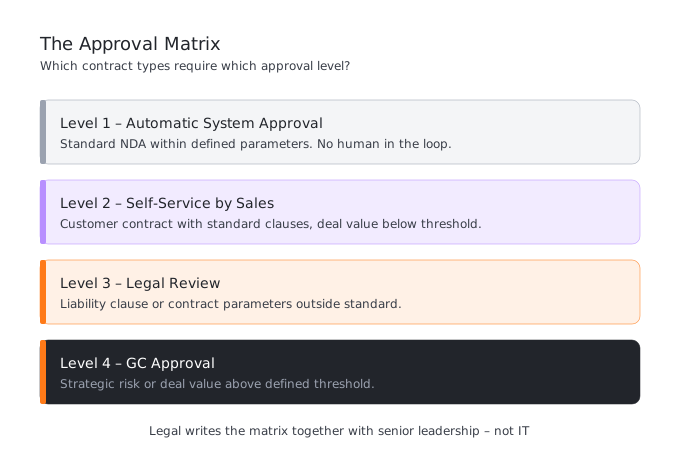
The approval matrix is a legal and business decision — not a technical configuration.
Level 1: Standard NDA within defined parameters → automatic system approval. No human in the loop.
Level 2: Customer contract with standard clauses, deal value below defined threshold → self-service approval by a senior sales representative.
Level 3: Contract with liability clause outside standard → legal review.
Level 4: Contract with strategic risk or deal value above defined threshold → General Counsel approval.
This matrix is not a technical configuration. It is a legal and business decision. Legal writes it — together with senior leadership.
Workflows That Work: From Request to Archive
A CLM system maps workflows. Which workflows get mapped determines the value of the system. Well-configured approval and workflow management is the difference between a system that relieves legal and a system that creates additional work for them.
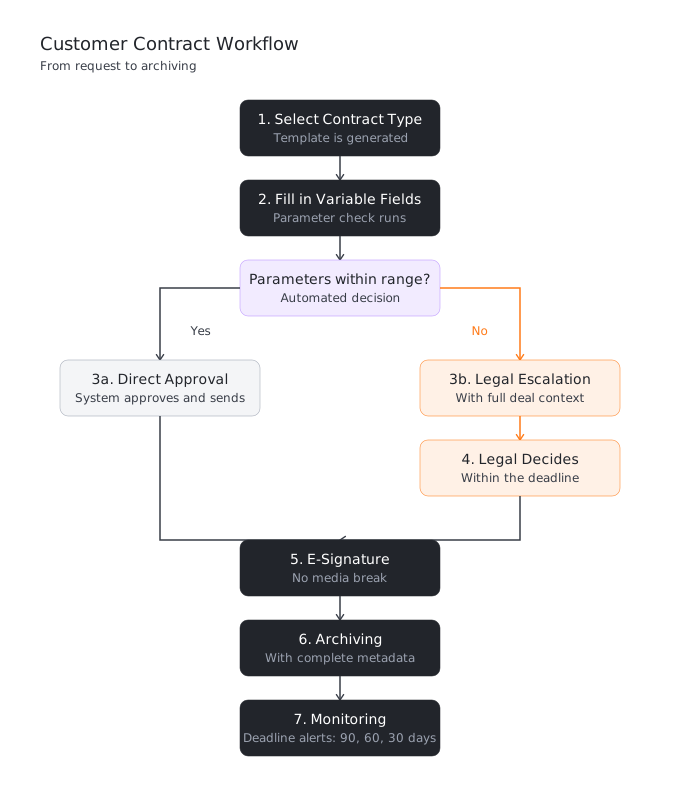
Customer contract workflow: Seven steps from contract type selection to automated deadline monitoring.
Step 1: Sales representative selects the contract type in the CLM system. The system automatically generates a contract draft based on the validated, current template.
Step 2: Variable fields are completed — counterparty, term, scope of services, price, payment terms. The system automatically checks whether the entered values fall within defined parameters.
Step 3a — Standard case: All parameters within range. The system approves the contract, sends it to the customer via the platform, and logs the transaction in full.
Step 3b — Deviation: A parameter falls outside standard. The system automatically escalates to legal, flags the affected clause, and passes the relevant deal context. Legal sees not just the contract but also: customer, deal value, sales owner, prior contract history.
Step 4: Legal decides, approves, or proposes alternative language — within the response deadline configured in the system.
Step 5: Signing via integrated e-signature. No media break, no email attachments.
Step 6: Automatic archiving with complete metadata: contract type, term, renewal date, termination deadline, clause tags, approval history.
Step 7: Automated monitoring. The system alerts responsible parties 90, 60, and 30 days before relevant deadlines — renewal, termination, price adjustment rights.
The critical point is Step 3b. The quality of the legal review depends on full context being available in the system. Systems that show only the modified contract without deal context force legal into research that costs time — and neutralizes the speed advantage the system was supposed to create.
Self-Service and Contract Automation: With Governance, Not Without
Contract automation is the largest source of efficiency in Contract Lifecycle Management. It is also the greatest risk when implemented without clear governance.
The principle: contract automation does not mean legal gives up control. It means legal moves control forward — from individual case review to system architecture.
What contract automation enables: Standardized contract types run without legal involvement. Sales and procurement generate, customize, and send contracts within defined parameters. The volume that previously sat on lawyers' desks disappears — not through delegation to outside counsel, but through system logic.
What contract automation requires: First, clean, current templates that legal reviews and updates regularly. Outdated templates in self-service are more dangerous than no templates — they suggest security that doesn't exist. Second, clear field boundaries: which fields are editable, which are locked? A sales representative should be able to adjust term and price. They should not be able to edit liability clauses. Third, automatic deviation detection: the system flags when an input falls outside defined parameters and escalates before a problematic contract is sent. Fourth, systematic monitoring: legal has visibility into all automated contracts and can identify patterns. If a particular clause is regularly modified by sales, that is a signal — either the template isn't fit for practice, or there is customer-side negotiation pressure that requires a strategic response.
For organizations looking to build structured, reusable legal standards that enable self-service at scale, Legartis's Contract Playbook Creator provides a practical starting point for encoding decision logic that the whole organization can act on. Teams looking to go further can explore agentic contract work with the Legartis Legal Agent.
Compliance Management for Contracts: What Is No Longer Optional in 2026
The regulatory context for contract compliance management has shifted fundamentally over the past two years. Three developments are particularly relevant for large organizations:
EU AI Act: Organizations that deploy or procure AI systems need contracts that reflect EU AI Act requirements — risk classification, transparency obligations, documentation requirements. CLM systems must recognize these contract types and treat relevant clauses as mandatory fields.
CSRD and ESG clauses in supplier contracts: The Corporate Sustainability Reporting Directive requires organizations to systematically capture and report ESG risks in their supply chain. Supplier contracts need ESG clauses, and those clauses must be configured in the CLM system in a way that enables compliance verification and reporting.
Data sovereignty as a compliance obligation: Contract clauses, negotiation positions, M&A correspondence — contract data is among the most sensitive information a company holds. US cloud services are subject to the CLOUD Act: US authorities can, under certain conditions, access data stored on servers located in Europe. European and Swiss providers are not subject to this exposure. This is not a technical footnote — it is a governance decision that belongs at board level.
Audit trails as standard, not option: Every contract change, every approval decision, every deviation from standard must be fully documented. For regulatory reviews, for M&A due diligence, for internal quality control. Contract management software that does not deliver complete audit trails does not meet the requirements of the 2026 regulatory environment.
What Contract Management Software Must Deliver — and What It Cannot
The CLM market is crowded. Over a hundred vendors position themselves in the enterprise segment. AI-powered features — automatic clause recognition, risk scoring, contract comparison — are today's baseline, not a differentiator. What actually differentiates:
Deep integration with existing systems. A CLM system that does not connect seamlessly with CRM, ERP, DMS, and internal communication tools creates media breaks. Media breaks are the primary reason sales teams abandon contract management software.
Configurability without development effort. Large organizations have individual contract structures, industry-specific clause requirements, multilingual contract environments. Modern SaaS solutions for legal and sales teams allow legal operations to configure templates, workflows, and approval rules independently — without an IT ticket. Systems that require development work for each edge case become expensive and slow.
AI that understands your organization. General AI that categorizes contract clauses is available everywhere. AI that knows your internal standards, learns from your own contract history, and assesses deviations in the context of your own risk parameters is a different product. The difference becomes visible when a system can distinguish between "this clause is unusual" and "this clause deviates from our standard language and created problems with this customer before."
Data sovereignty as a product feature, not fine print. For organizations managing sensitive contract portfolios, the answers to where data is stored and which legal jurisdiction governs the provider are selection criteria — not details for the IT department.
Legartis is a Swiss provider offering a Legal Workspace that makes legal knowledge accessible across the entire organization — with servers exclusively in Switzerland and Europe, without exposure to the US CLOUD Act. The platform learns from every interaction and adapts to the internal standards of each organization. Learn more about AI contract review and contract insights.
The KPIs That Actually Matter
A CLM implementation without measurement has no learning curve. The relevant KPIs for legal and sales:
Process: Time from contract request to signature — broken down by contract type and approval level. Share of contracts handled in self-service. Escalation rate: what percentage of contracts requires legal review, and how does that trend over time?
Compliance: Share of contracts with complete audit trail. Number of clause deviations from standard per quarter. Share of contracts with timely monitoring alerts before term expiry.
Business: Time-to-revenue — the time from closed deal to signed contract. Avoided external legal costs through standardization and contract automation. Share of sales cycles where contract speed was cited as an explicit factor.
The most important KPI missing from most reports: the share of contracts that legal never saw — because the approval and workflow management was configured correctly. That is the measure of a successful legal architecture, not the utilization rate of the lawyers.
Conclusion
CLM implementations don't fail because of the technology. They fail because organizations try to solve a software problem that is, in reality, an organizational and structural one.
Contract management software delivers its value only when legal and sales want the same thing: faster, more consistent contracts with clear governance. That requires legal to be willing to systematize and scale its decision logic — and sales to be willing to work within a system that initially demands adjustment.
The regulatory requirements of 2026 make this step more urgent than it has ever been. Organizations that don't manage contracts systematically today have a compliance problem tomorrow. Those that get it right gain speed, transparency, and strategic capacity.
The question is not whether. It is when — and how.
Get Started with Legartis — Today
Legartis is built to get you up and running fast. No months-long implementation, no IT project. Define your legal standards, configure approval workflows, enable your sales team — and see measurable results within weeks.
Try Legartis for free and experience what modern contract management looks like in practice.
Explore Related Insights
More articles related to this topic



Start with Legartis Today!
Talk to us about your business case or test Legartis right away!