AI Contract Management: What AI Can Really Do Across the Contract Lifecycle Today
Table of contents
AI in contract management is often sold as a promise: faster, simpler, more automated. The real question is which tasks AI can reliably take on, what a human must still decide, and how good an AI has to be before legal teams can trust it.
AI in contract management is often sold as a promise: faster, simpler, more automated. But anyone working in an in-house legal team knows the real question behind the hype — not “Can AI handle contracts?”, but: which tasks can AI reliably take on, what must a human still decide, and how good does an AI have to be before I can trust it in a legal context at all?
This guide answers exactly those questions. It shows the five areas where AI makes a measurable difference in contract management today, draws the limits honestly — and explains why not every AI is equally suited to legal work.
What Is AI Contract Management?
AI contract management refers to the use of artificial intelligence to support, accelerate, and improve the quality of tasks across the entire contract lifecycle — from drafting and review to obligation tracking and portfolio analysis.
The distinction matters: AI contract management is not a process of its own, but a capability layer that sits on top of an existing contract process. The underlying process — who creates, reviews, approves, and monitors which contract and when — remains Contract Lifecycle Management (CLM). AI doesn't change which phases a contract passes through. It changes how much of that becomes automatable, measurable, and scalable.
This is exactly where a digitised contract process differs from an intelligent one. How far a company sits along this maturity spectrum is described by the concept of Intelligent Contract Management.
The 5 Areas Where AI Makes a Difference
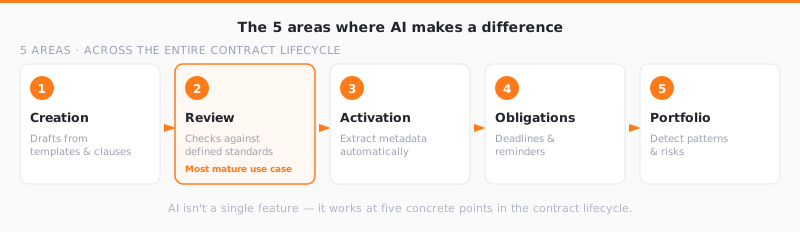
AI in contract management is not a monolithic feature. It works at five concrete points in the contract lifecycle — and its value differs significantly from area to area.
1. Contract Creation & Drafting
AI can generate first drafts from approved templates and clause libraries, suggest missing standard clauses, and align wording with internal standards. The effect is greatest when the AI doesn't write freely, but builds on a stored contract playbook — that is, on the clauses and positions your team intends to enforce anyway. This turns text generation into controlled standardised drafting.
2. Contract Review with AI
The most mature use case. AI checks incoming contracts against defined standards, flags deviations, identifies missing or risky clauses, and delivers a first assessment before a human steps in. The reason for that maturity: review is a clearly bounded use case. There is a contract text, defined standards, and verifiable deviations. That is precisely why quality is easier to measure here than with freely generated legal answers.
A good AI contract review doesn't replace legal judgment — it pre-sorts, prioritises, and makes every assessment traceable down to the specific clause. That is what scales: reviews that used to take hours become minutes of control.
3. Metadata Extraction & Activation
Once signed, a contract needs to become searchable, structured, and actively monitored. AI automatically extracts the relevant metadata — counterparty, contract type, term, termination deadlines, value, governing law — and categorises the document. This turns filing from an endpoint into the starting point of active governance.
4. Obligation Tracking
Most contracts create ongoing obligations: delivery deadlines, payment milestones, SLA thresholds, reporting duties. AI identifies these obligations from the contract text and converts them into trackable deadlines with automatic reminders. This is the area that most often slips through the cracks in manual processes — and where AI defuses the most risk.
5. Portfolio Analysis & Risk Detection
At portfolio level, AI detects patterns that remain hidden to an individual reviewer: recurring deviations from a standard clause, unusual risk concentrations, upcoming renewal waves. Contract Insights turns a static contract archive into an analysable database — and makes contract work governable in the first place.
What AI Cannot (and Should Not) Take On
An honest guide names the limits. In contract management, AI is a tool for preparation and scaling — not for the final judgment. Four areas remain human:
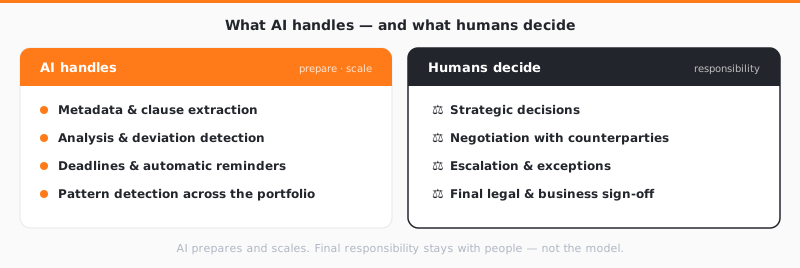
- Strategic decisions. Whether a risk is acceptable depends on the business context — which the AI doesn't know.
- Negotiation. AI can prepare positions and supply arguments, but negotiating with a counterparty remains a human, relationship-driven task.
- Escalation and exceptions. When a deviation is tolerable and when it must be escalated is a matter of judgment.
- Final approval. Responsibility for the final legal and business sign-off lies with people — not with the model.
The consequence: an AI that doesn't explain its assessments is barely usable in a legal context. If a human carries the final decision, they need to understand why the AI flagged a clause as risky. That leads directly to the decisive distinction.
Why Not Every AI Is Suited to Contract Work
The market confuses good output with reliable AI. But with Legal AI, whether an output sounds good isn't enough. What matters is how verifiable the path to that output is. That is exactly what separates simple AI tools from auditable Legal AI systems. Legartis describes this difference in four quality levels:
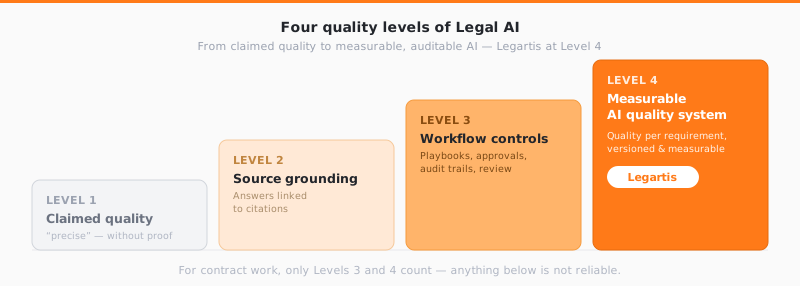
- Level 1: Claimed quality. The solution promises precise or trustworthy results without disclosing how that quality is verified.
- Level 2: Source grounding. Answers are linked to citations in the contract. This improves traceability but does not yet replace systematic quality control.
- Level 3: Workflow controls. Playbooks, approvals, audit trails, and human reviews are built into the process.
- Level 4: Measurable AI quality system. Quality is measured per requirement, versioned, reviewed, and improved through feedback loops — the Legartis position.
For contract work, only Levels 3 and 4 count. And Level 4 is often misunderstood: what matters is not a general accuracy score, but quality per requirement. Does the AI catch this specific clause? Does it flag the right deviation? Does it deliver the same assessment consistently across comparable contracts? That is what separates an AI that produces impressive text from an AI that a legal team can hand real responsibility to.
A Legal AI for contract work must therefore meet six properties: it is measurable, controllable, traceable, consistent, improvable, and auditable. More on this in the Legartis AI Quality System.
How to Evaluate AI Solutions for Your Contract Management
Anyone selecting an AI solution for contract management should look beyond demos with impressive output. These six questions separate useful from superficial solutions:
- Does the AI work against your standards? A solution without storable playbooks assesses contracts against generic standards — not your own.
- Is every assessment traceable? Can each flag be traced back to the specific clause and the underlying rule?
- Does the solution cover the full lifecycle — or only the phases before signature? The phases after signature are where most tools stop and most risk sits.
- Does it deliver measurable quality? Are there quality scores, cycle times, deviation rates — or just a document archive?
- Does it fit into existing workflows? A solution that creates a parallel process won't be adopted.
- Is the AI auditable? Every decision, change, and review should be documented end to end for compliance and governance.
For a detailed market overview with evaluation criteria, see our CLM Software Guide 2026.
AI Contract Management vs. AI Contract Review: What's the Difference?
The two terms are often used interchangeably — but they describe different scopes.
AI contract review is a single, clearly bounded use case: the AI-supported review of a contract against defined standards. It is the most mature and most widely used AI use case in contract management.
AI contract management is the umbrella term. It covers review as one of five areas — alongside creation, activation, obligation tracking, and portfolio analysis. Whoever runs “just” review uses AI at one point of the lifecycle. Whoever runs AI contract management applies it across the entire cycle.
In practice, AI contract review is usually the entry point — the area with the fastest, most measurable value. From there, AI usage grows step by step across the rest of the lifecycle.
This is exactly where point-solution AI differs from a Legal AI Workspace: the AI doesn't work in isolation on individual documents, but along defined standards, workflows, and quality metrics.
Govern contracts with AI — not just process them faster. The Legartis Legal AI Workspace connects creation, review, obligation tracking, and analysis in one environment — with AI results that remain traceable, measurable, and controllable. Book a demo.
Frequently Asked Questions about AI Contract Management
What is AI contract management?
AI contract management refers to the use of artificial intelligence to support tasks across the entire contract lifecycle — from drafting and review through metadata extraction and obligation tracking to portfolio analysis. AI is not a process step of its own, but a capability layer on top of an existing contract process.
Which contract management tasks can AI take on?
AI works in five areas: contract creation based on templates, contract review against standards with AI, automatic metadata extraction after signature, obligation tracking with automatic reminders, and portfolio analysis for risk and pattern detection.
What can AI not do in contract management?
AI does not make strategic decisions, does not negotiate independently with counterparties, does not decide on escalations, and does not carry the final legal responsibility. These tasks remain with people — AI prepares, scales, and makes work traceable.
What is the difference between AI contract management and AI contract review?
AI contract review is a single use case — the AI-supported review of a contract. AI contract management is the umbrella term covering review as one of five areas, alongside creation, activation, obligation tracking, and portfolio analysis.
How good does an AI have to be for legal teams to trust it?
In a legal context, a plausible answer isn't enough. A trustworthy Legal AI must be measurable, controllable, traceable, consistent, improvable, and auditable. Every assessment must be traceable down to the specific clause and the underlying rule.
Does AI replace Contract Lifecycle Management?
No. CLM describes the process — which phases a contract passes through and who is responsible. AI doesn't change the phases; it makes them automatable, measurable, and scalable. AI contract management sits on top of CLM, but does not replace it.
What should I look for when choosing an AI contract management solution?
Six criteria: Does the AI work against your own standards (playbooks)? Is every assessment traceable? Does it cover the full lifecycle, including after signature? Does it deliver measurable quality? Does it fit into existing workflows? And is it auditable for compliance?
Where does AI deliver the fastest value in contract management?
Contract review with AI is usually the entry point — the most mature use case with the fastest, most measurable value. Reviews that took hours manually become minutes of control. From there, AI usage grows step by step across the rest of the lifecycle.
Explore Related Insights
More articles related to this topic



Start withLegartis Today!
Talk to us about your business case or test Legartis right away!