Contract Management Best Practices: 8 Rules for In-House Legal Teams
Table of contents
Good contract management practice doesn't come from more administration. It comes from organising contracts so that standards are upheld, ownership is clear, deadlines don't get lost, and quality becomes measurable.
Most advice on better contract management boils down to one thing: more tools, more administration, more process. But good contract management practice doesn't come from more administration. It comes from organising contracts so that standards are upheld, ownership is clear, deadlines don't get lost, and quality becomes measurable.
This guide shows the most important contract management best practices for in-house legal teams — not as a theoretical overview, but as an operational playbook. Eight concrete rules, each following the same pattern: the problem, the best practice, the result. Plus the most common mistakes and a rollout plan that doesn't require changing everything at once.
What Good Contract Management Practice Really Means
“Best practice” in contract management doesn't mean running the most sophisticated system. It means reliably ensuring four things: that every contract follows the same standards, that someone is responsible for every phase, that nothing slips through the cracks after signature — and that the quality of contract work can be measured and therefore improved.
Everything else — software, automation, AI — is a means to an end. It only works once these four foundations are in place. The eight rules below build on exactly that. For the full lifecycle behind them, see Contract Lifecycle Management.
The 8 Contract Management Best Practices
AI in contract management is not a monolithic feature — and neither is good practice. Each of the following eight rules tackles a distinct point of failure.
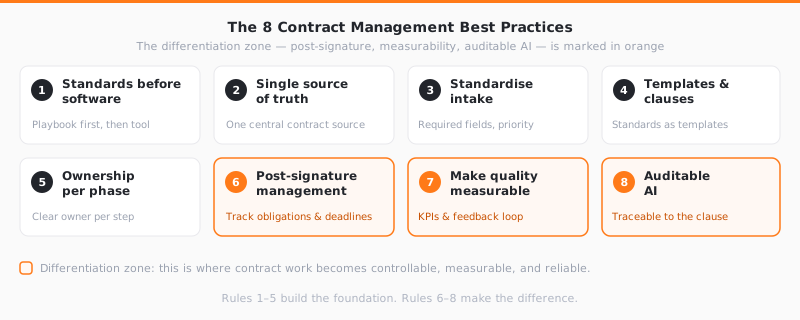
1. Standards Before Software
Problem: A tool is rolled out before anyone has defined what a good contract actually looks like — the result is a digital system with no controllable quality.
Best practice: Define standards first: which clauses are mandatory? Which deviations are acceptable? When do you escalate? These rules belong in a contract playbook.
Result: Every tool then only implements what's already clearly defined — instead of reproducing inconsistency faster.
2. Create a Single Source of Truth
Problem: Contracts are scattered across inboxes, local folders, and drives. No one knows reliably which version is current.
Best practice: A single contract source where every contract is findable with structured metadata (counterparty, type, term, deadlines).
Result: No more searching. Deadlines and obligations become visible instead of disappearing into PDFs.
3. Standardise the Intake Process
Problem: Requests reach legal by email, chat, or word of mouth — with no prioritisation, no deadline, no documented context.
Best practice: A standardised intake with required fields: contract type, counterparty, target deadline, value, risk flags.
Result: Legal can prioritise, spot risks earlier, and measure cycle times in the first place.
4. Work From Templates and Clause Libraries
Problem: Every contract is drafted from scratch — costing time and creating inconsistency across the portfolio.
Best practice: Approved templates and a maintained clause library as the starting point for every draft. They translate the standards from the playbook (rule 1) into concrete working tools — turning decision logic into an operational template.
Result: Faster drafting, less negotiation effort, consistent quality.
5. Define Ownership for Every Phase
Problem: Unclear responsibility means phases get skipped — especially after signature, where legal and the business pass responsibility back and forth.
Best practice: Every phase of the contract lifecycle has a clearly named owner: legal owns standards and escalations, sales or procurement the commercial context, finance the payment and value thresholds, operations the ongoing obligations.
Result: Nothing falls between departments; every phase is reliably completed.
6. Take Post-Signature Management Seriously
Problem: In many companies, contract management ends exactly where contract risk operationally begins: after signature. Obligations sit in PDFs, termination deadlines are tracked manually, renewals run through unnoticed.
Best practice: Track obligations, SLAs, and deadlines systematically — with automatic reminders instead of calendar entries. This is where the majority of contract risk sits.
Result: No missed termination windows, no unwanted auto-renewals, no undetected SLA breaches.
7. Make Contract Quality Measurable
Problem: No one knows how consistently standards are actually upheld — and without measurement there is no improvement.
Best practice: Define metrics: cycle time per phase, deviation rate, standard adherence, escalation frequency. A solution like Contract Insights makes this data visible at portfolio level.
Result: A feedback loop emerges — contract work improves systematically instead of by gut feeling.
8. Use AI — Where It Works Traceably and Auditably
Problem: Black-box AI produces plausible results that can't be verified in a legal context — and therefore can't be owned.
Best practice: Use AI where every assessment is traceable down to the specific clause and the underlying rule — for example in AI contract review. Auditability is the condition, not the extra.
Result: Contract work scales without losing control and traceability. More on this in the AI Quality System and the overview of AI Contract Management.
The Most Common Contract Management Mistakes
The eight rules can be mirrored — the most common mistakes are exactly their opposite:
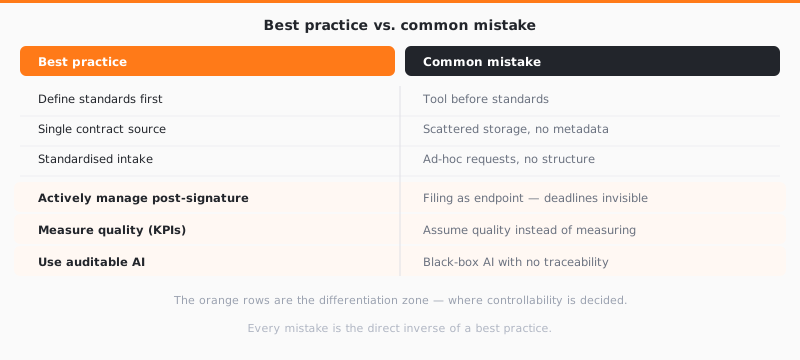
- Tool before standards. Software is rolled out before it's clear what should be reviewed — which automates existing inconsistencies.
- Scattered storage. Contracts sit spread out with no central repository and no metadata — no one knows reliably which version is current.
- Ad-hoc intake. Requests arrive with no structure or prioritisation — legal can neither steer nor measure cycle times.
- Filing as the endpoint. Contracts are stored after signature but not actively managed — obligations and deadlines stay invisible.
- No metrics. Quality is assumed rather than measured — leaving no basis for improvement.
- Black-box AI. AI results can't be traced back to the clause — and therefore can't be owned in a legal context.
Rollout: How to Introduce Best Practices in 3 Steps
The most common rollout mistake is trying to change everything at once. A step-by-step rollout works better:
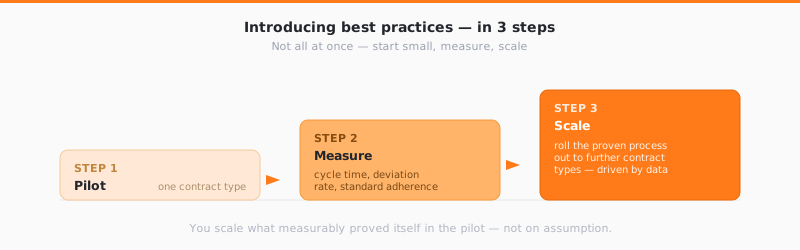
- Pilot. Start with one contract type that carries high volume or high risk — NDAs or service agreements, for instance. Set up standards, templates, and intake cleanly there.
- Measure. Capture metrics: cycle time, deviation rate, standard adherence. These numbers are the proof of business value — and the basis for the next step.
- Scale. Roll the proven process out to further contract types — driven by data, not by assumption.
Good contract management practice doesn't come from a tool alone. It emerges when standards, workflows, contract data, and quality come together in one shared system. The Legartis Legal AI Workspace connects these layers — from playbooks and review through to Contract Insights and auditable Legal AI. See contract management in the Legal AI Workspace.
Frequently Asked Questions about Contract Management Best Practices
What are the most important contract management best practices?
The most important best practices: begin with standards rather than software, store contracts centrally, standardise intake, work from templates and clause libraries, define clear ownership for every phase, take post-signature management seriously, make contract quality measurable, and use AI only where it's auditable.
Where should I start?
With standards, not software. First define which clauses are mandatory, which deviations are acceptable, and when to escalate. These rules are the foundation for every tool and every automation.
What is the most common mistake in contract management?
That management ends at signature. After signing, obligations are tracked manually and deadlines are forgotten — yet this is where the majority of contract risk sits, from missed termination windows to unwanted auto-renewals.
Do I need software for good contract management?
Software helps, but it doesn't replace standards. Without defined playbooks, a tool only transfers existing disorder into a digital system. Only once standards, ownership, and metrics are in place does a solution deliver value. For a market overview, see the CLM Software Guide 2026.
How do I make contract quality measurable?
Through metrics such as cycle time per phase, deviation rate from standards, standard adherence rate, and escalation frequency. These metrics create a feedback loop that lets you improve the contract process systematically.
What does post-signature management mean?
The active management of a contract after signature: tracking obligations, monitoring SLAs, and proactively managing deadlines and renewals. It's the phase most often neglected in practice — and the one that carries the most risk.
What are the risks of poor contract management?
Poor contract management practice leads to missed deadlines, uncontrolled deviations from standards, unclear responsibilities, longer cycle times, and risks that only surface once they're already business-critical — such as unwanted auto-renewals or unmet SLAs.
What role does AI play in contract management best practices?
AI can accelerate drafting, review, and obligation tracking — but only if it's auditable. In a legal context, every assessment must be traceable down to the specific clause. Black-box AI doesn't meet that requirement.
Do these best practices also apply to smaller teams?
Yes. The rules scale with contract volume and risk profile. Smaller teams benefit especially from standardised intake, templates, and deadline tracking — because that's where a little effort defuses a lot of risk.
Explore Related Insights
More articles related to this topic



Start withLegartis Today!
Talk to us about your business case or test Legartis right away!