Contract Negotiation Software: What It Is and How AI Helps
Table of contents
Most contract negotiation tools describe themselves the same way, so feature lists are little help. This guide explains what the software really does, which capabilities matter, and the one criterion that separates a fast tool from one you can stand behind.
If you search for contract negotiation software, you notice quickly that the tools describe themselves in almost the same words. Faster reviews, fewer errors, smoother collaboration, AI that redlines for you. On a feature list they are close to interchangeable. So the useful question is not which tool has the longest list, but which one you can actually rely on after a contract has been through several rounds of edits and gets signed under deadline. This guide walks through what contract negotiation software does, which capabilities genuinely matter, and the one criterion that separates a fast tool from one you can stand behind.
What contract negotiation software does
Contract negotiation software manages a contract through the stretch from first draft to signature, and in practice that comes down to a handful of core capabilities:
- Redlining and clause review. It reads an incoming draft and flags clauses that are risky, missing, or not the way your company writes them.
- Fallback wording. It offers alternative language that legal approved in advance, so a business user can hold a position without inventing terms.
- Version control and comparison. It keeps one source of truth and shows exactly what changed between rounds.
- Collaboration. Legal, sales and procurement work on the same document, with roles and approvals built in.
- Audit trail. Every change, approval and accepted deviation is recorded, so the signed contract carries its own history.
Most established contract negotiation software does all of this competently. That is the baseline of the category, not the thing that should decide your choice. The first of those capabilities has a craft of its own, and our guide to contract redlining covers how to mark up, assess and agree changes in practice.
Good contract negotiation software does not just move contracts faster. It keeps your standard intact across every negotiation round and creates the record to prove it. That is the line this guide keeps coming back to.
Why negotiation is harder to control than it looks
The reason a negotiated contract is risky has surprisingly little to do with any single clause. It is that standards drift. One reviewer accepts a slightly weaker liability cap to keep a deal moving. On the next deal, someone else accepts different wording for the same clause. Each decision is defensible on its own, yet across hundreds of contracts your risk position shifts, one reasonable concession at a time, and nobody is tracking the shift.
That is the real job of negotiation software, and it is where tools quietly diverge. Managing versions and routing approvals is mechanical, and everyone does it. Keeping your standards constant on every deal, and being able to show afterwards that you did, is the harder part, and most tools do not really deliver it.
Where contract negotiation software creates the most value
Not every contract justifies this machinery, and the payback is highest where the same clauses come up again and again. High volume NDAs and sales contracts are the clearest case. They are often negotiated by sales teams under time pressure, and fallbacks approved in advance let a representative move quickly while legal keeps control of the terms. SaaS and software agreements bring the same contested clauses to almost every deal, above all liability, data protection and automatic renewal, and it is exactly there that one inconsistent concession tends to become the precedent for the next. Procurement teams gain in a similar way, because they negotiate many supplier agreements against the same internal risk policies and need them applied identically every time. Even lower volume, higher sensitivity agreements such as employment or partnership contracts benefit, though there the value is less about speed and more about a clean, defensible record of what was agreed. The pattern is consistent across all of them. The more often a contract type repeats, the more a standardised, software driven negotiation pays back.
What AI adds to contract negotiation software
AI has made negotiation software far more capable. A modern tool can read an incoming draft, flag the clauses that stray from your standards, propose fallback wording, and summarise what changed between versions. The catch is that a fluent suggestion is not the same as proof that the change meets your standard. A generic assistant can produce a confident redline that still misses your risk policy, and nothing in the process would tell you.
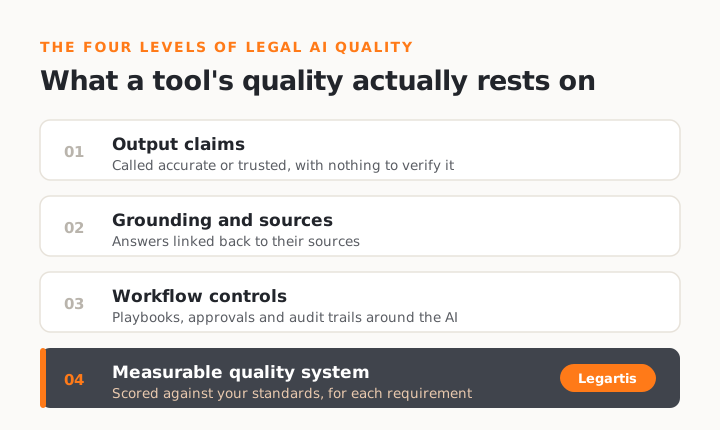
A simple way to judge how far a tool really goes is to ask what its quality rests on:
- Output claims. It calls itself accurate or trusted, with nothing verifiable behind the word.
- Grounding. Its answers are tied to sources, so you can see where they came from.
- Workflow controls. Playbooks, approvals and audit trails wrap the AI in a process.
- Measurable quality. The system scores how reliably it meets each requirement, and lets you improve that over time.
Most tools stop somewhere in the middle of that scale, which is useful but not decisive. The ones worth shortlisting reach the top, where quality is measured against your standards rather than simply asserted.
What to look for when you choose
Because the feature lists look alike, the fairest way to compare tools is on control rather than capability. A few questions separate them faster than any demo:
- Can you define your own playbooks and fallbacks, so every draft is judged against your rules and not the model's general instinct?
- Can you see reliability for each requirement, instead of a single headline claim about accuracy?
- Is there a complete record, with timestamps, of every change, approval and deviation, ready for an audit rather than reconstructed after one?
- Do the fundamentals fit, meaning your contract types, your languages, and the tools you already use?
- Does it meet the security standards that are not negotiable for legal data, such as data residency, ISO 27001 and GDPR?
A tool that answers the first three convincingly is doing the thing that actually matters. This is the criterion the whole category comes down to. The question is not whether the software is fast, but whether it holds your standard on every deal and can prove it. It is the same principle behind auditable Legal AI, which is quality you can measure and defend rather than merely trust. Legartis is built around it. A contract playbook turns your standards into rules that apply to every draft, and an AI quality system shows how reliably each requirement is met, so you can raise it deliberately instead of hoping the next model is better.
The quick way to read all of this is a single contrast. A tool built for control measures its work against your standards and can show what it did. A tool built only for speed asserts that it is accurate and generates fluent text. Both look impressive in a demo, but only the first is something legal can defend afterwards.
What that looks like in one clause
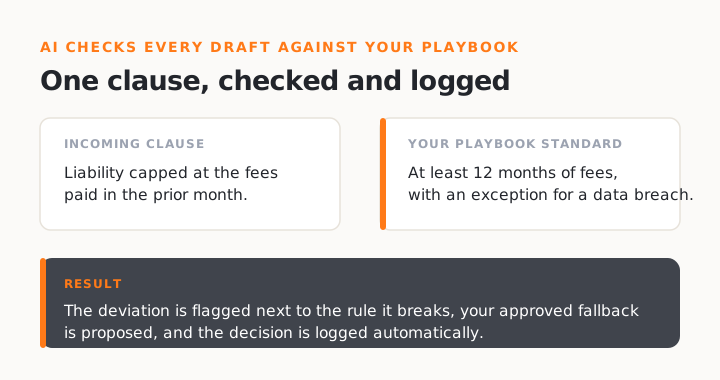
An example makes the difference concrete. A software vendor returns your order form with a single change. Their liability is now capped at the fees paid in the previous month, while your playbook requires a cap of at least twelve months of fees, with an exception for liability from a data breach. A basic tool tells you the clause changed. A tool that only generates text might even rewrite it for you, plausibly. A system built for measured quality recognises the new wording as a deviation from a specific rule, shows it next to the standard it breaks, and offers the fallback your legal team already approved. The reviewer accepts, adjusts or escalates, and that decision, with its reason, is written to the record automatically. The clause never slips through unnoticed, a colleague who is not a lawyer can handle the standard case within safe limits, and months later, when an auditor asks why the cap was accepted, the answer is already on file.
Contract negotiation software vs. contract management software
It is worth clearing up a common confusion, because vendors use the terms loosely. Contract management software, usually shortened to CLM, spans the whole lifecycle, from creating and storing contracts to tracking obligations and renewals, and our overview of contract software covers that wider picture. Contract negotiation software concentrates on the phase from first draft to signature. The two are complementary, and the risk lies in the handover between them. Standards set while drafting have to survive negotiation, and obligations agreed in negotiation have to stay visible after signing. That is why negotiation works best as part of a connected workspace, where AI contract review prepares a clean first draft and Contract Insights turns the signed portfolio into a living view of obligations and risk.
The bottom line
Contract negotiation software has already won the argument about speed, and almost every tool can move a contract to signature faster. Far fewer can show that the signed contract still meets your standards, and fewer still can prove it clause by clause when someone asks. When you compare options, that is the line worth testing for. It is the difference between a convenient assistant and negotiation you can defend.
To see auditable contract negotiation in practice, book a demo, or read the Legal AI Guide 2026.
FAQ
Frequently asked questions
Contract negotiation software manages a contract from first draft to signature. It handles the exchange of drafts, the redlining of clauses, the comparison of versions and the routing of approvals, and it checks each draft against the standards your company has set, all in one workflow that can be audited rather than in email and PDF round trips.
AI reads each negotiated draft, flags clauses that stray from your standards, proposes fallback wording, summarises what changed, and records every decision, which makes negotiation both faster and more consistent. What matters is whether the AI is measured against your requirements, clause by clause, rather than simply producing fluent text.
Because feature lists look alike, compare on control. Look for playbooks and fallbacks you can define yourself, reliability you can see for each requirement, a complete audit trail of changes and approvals, support for your contract types and languages, and security standards such as data residency, ISO 27001 and GDPR. The decisive question is whether the tool holds your standard on every deal and can prove it.
A CLM covers the whole contract lifecycle, from creating and storing contracts to tracking and renewing them. Negotiation software focuses on the phase from drafting to signature, which is redlining, versions and approvals. Legartis handles negotiation as part of a Legal AI Workspace, so the same standards apply before, during and after negotiation.
Yes, within limits defined by legal. When standards live in a playbook and fallbacks are approved in advance, sales and procurement can handle routine negotiation steps while legal keeps control of the standards and the exceptions.
It depends on whether the quality can be measured. A generic assistant produces plausible edits with nothing behind them. A system built for measured quality checks each draft against defined requirements, scores how reliably it meets them, and keeps a full record, so the result can be defended rather than simply trusted.
Explore Related Insights
More articles related to this topic



Start with Legartis Today!
Talk to us about your business case or test Legartis right away!