
Reviewing NDAs in Companies: Why Standard Templates Are Risky
Table of contents
Non-disclosure agreements (NDAs) are among the most frequently used contracts in organisations.
Non-disclosure agreements (NDAs) are among the most frequently used contracts in organisations. They are signed every day – between Sales and potential clients, between HR and candidates, between Operations and suppliers or partners.
And although NDAs are often treated as a routine document, they carry a surprisingly high risk potential.
This guide explains:
- why off-the-shelf NDA templates can be dangerous
- which elements are essential in every NDA review
- how Legal AI solutions accelerate and standardise the review process
- and when a manual review is still worthwhile
Why standard NDAs can be problematic
Many organisations use NDAs from previous projects or generic templates found online. These documents may look harmless – but small wording choices can create far-reaching risks.
The most common risk areas:
1. Outdated or imprecise clauses
Many NDAs originate from a time when digital supply chains, cloud services or international data flows were barely considered.
If these elements are missing, the agreement often fails when tested in practice.
2. Imbalanced obligations
One-sided NDAs can impose disproportionate or unrealistic obligations on a company.
Typical pitfalls include:
- liability only on one side
- overly broad definitions of “confidential information”
- vague or overly wide purpose-of-use restrictions
3. Missing best-practice standards
Modern NDAs should include clear rules for:
- return or deletion of information
- permitted subcontractors
- handling of IP
- exceptions for already public information
Older templates often lack these completely.
4. Inconsistencies between versions
When teams frequently copy-and-paste NDAs, inconsistencies emerge.
The result: ambiguous wording, contradictory sections or clauses that no longer fit together.
5. Manual review under time pressure
Legal teams often work under enormous time pressure.
Routine NDAs are then reviewed only superficially – understandable, but risky.
Practical tip: You can have your NDA reviewed in under one minute — completely free — using a lawyer-verified AI.

Checklist: What you should review in every NDA
A solid NDA review begins with a structured checklist.
The following points should always be assessed critically:
1. Definitions and exceptions
- Is “confidential information” clearly defined – and not too broad?
- Are exceptions sufficiently precise?
2. Purpose limitation
- May the information only be used for the agreed purpose?
- Are there vague or overly wide purpose extensions?
3. Disclosure to third parties
- Which subcontractors are permitted?
- Are adequate security measures required?
4. Return or destruction of information
- Is there an obligation to return or delete information?
- Is the timeframe clearly defined?
5. Duration and survival clauses
- Is the confidentiality period appropriate?
- Do specific obligations survive termination?
6. Liability and consequences
- Are liability risks fairly allocated?
- Does the NDA contain sanctions that are unenforceable or disproportionate?
7. Governing law and jurisdiction
- Is the chosen jurisdiction suitable for both parties?
- Does it create operational risk?
8. Structure and consistency
- Do the clauses logically fit together?
- Are there duplicate or contradictory provisions?
A proper NDA review involves far more than “quickly reading through the document”.
How AI supports NDA review
Legal teams regularly review large volumes of NDAs – often under significant time pressure and with limited resources.
This is where modern AI-assisted contract review solutions provide valuable support.
Important: AI does not replace legal advice in complex cases.
But it is highly effective for routine, standardised reviews.
Benefits of AI-supported NDA reviews
1. Speed
AI identifies deviations, risks and missing clauses within seconds.
2. Consistency
An AI review is reproducible.
The same contract → the same assessment.
This prevents different reviewers from reaching different conclusions.
3. Best-practice standards
Tools like Legartis use a playbook developed by legal experts – not just statistical text predictions (as in generative AI).
4. Transparent recommendations
AI clearly shows:
- why a clause is risky
- what is missing
- and how best-practice language typically looks
5. Supportive functions
An AI assistant can answer follow-up questions or explain specific clauses.
If you want to see how AI evaluates your NDA:
Legal AI vs. generative AI: What’s the difference?
Many people experiment with models like ChatGPT to analyse contracts.
But generative AI has fundamental limitations:
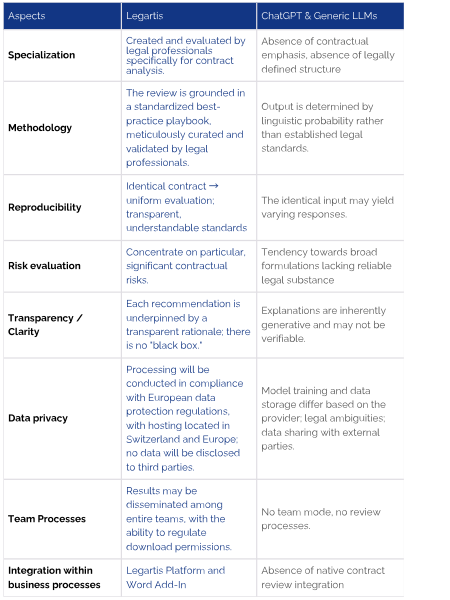
In short: Generative AI can write, but it cannot review.
Reliable NDA reviews require a structured, legally defined methodology.
How companies review NDAs efficiently today
Organisations typically use three approaches:
A) Manual – when the case is complex
Recommended for:
- IP-heavy NDAs
- NDAs with special liability regimes
- international or highly customised agreements
B) Hybrid – manual + AI
The standard approach:
AI detects issues → Legal performs the final review.
C) Fully automated – for routine NDAs
Ideal for everyday NDAs in sales, HR or procurement.
AI dramatically reduces review time.
Tools for NDA review: Recommendations for companies
Legartis offers two straightforward entry points:
1. Free NDA Review (no cost)
- 2 NDA analyses per month
- immediate results
- AI assistant for follow-up questions
- no credit card required
→ Ideal for teams wanting to test AI-based review without commitment.
Conclusion
NDAs may look simple at first glance, but they are legally and operationally significant. Standard templates or copy-paste versions often omit important best-practice provisions – and create avoidable risks.
A strong NDA review requires:
- a structured checklist
- an understanding of critical clauses
- a consistent review framework
AI-based tools help make these reviews faster, more reproducible and more robust – especially at scale.
If you want to review your NDA now.
Explore Related Insights
More articles related to this topic



Start withLegartis Today!
Talk to us about your business case or test Legartis right away!
