Contract Review AI 101: What Every Business Should Know
Table of contents
Most businesses have a contract review process. Very few have one that holds up under volume. In this post, Legartis CEO David A. Bloch breaks down what contract review actually involves, the three places it silently fails as companies grow, and how AI contract review automation for legal teams — built around a structured playbook — cuts a 60-minute manual review to under 10 minutes.
Every business does it. But most treat it as just a box to check — and nothing more.
Having spent nearly a decade helping enterprise legal, sales, and procurement teams with this specific problem, I've seen what happens when contract review becomes a bottleneck. I've seen the missed obligations, the inconsistent risk calls, the legal teams blamed for slowing down businesses they were actually trying to protect.
So here's a straightforward walkthrough of where contract review tends to go wrong at scale, how AI contract review is changing it, and what you need to make your process more effective.
What Contract Review Actually Involves
Ask most people what contract review is, and you'll hear the same description: a lawyer reads a contract, flags risks, signs off. That's not wrong. But it's also why so many legal departments are quietly drowning.
The old model treats contract review as a reading exercise — the reviewer catches what they happen to notice. That works at a few dozen contracts a year. At hundreds, the cracks show. At thousands, it's broken.
Real contract review at scale isn't reading. It's comparing. You're comparing every clause against a set of standards your company has already decided on — risk thresholds, preferred clauses, fallback positions if a counterparty pushes back. The job isn't reading harder. It's reading against something specific.
The old model has a second flaw: it treats every contract the same. Same scrutiny, regardless of risk. That's where triage comes in.
Triage works on signals you can read before opening the document. Is it your paper or theirs? Is the counterparty new, or someone you've worked with for years? What's the contract value? Is it a standard NDA or a complex licensing agreement?
A new counterparty submitting their own paper for a high-value licensing deal needs senior legal attention from the start. A routine renewal with a vendor you've worked with for five years rarely needs more than a quick check. Most contracts sit somewhere in between — standard terms with some negotiation, where you need to catch deviations from your standards, but you don't need a partner-level lawyer reading every clause.
Sort before you read. Otherwise your team spends the same hour on a routine renewal as on a deal that could expose you to seven figures of liability.
Where Contract Review Goes Wrong at Scale
All of that works well when you're handling a manageable number of contracts. Once volume goes up, the process stops working the way it did when the team was smaller — and nobody notices until there's a problem.
Here's what it looks like when contract review breaks at scale.
First, contracts stop getting reviewed at all. They go straight from sales or procurement to signature because legal can't keep up.
Second — and this is the more dangerous one — contracts still get reviewed, but not properly. Anyone who's worked in a legal department knows the pattern. End of quarter, everyone wants their contracts signed off. The mistakes don't happen on the first contract of the morning. They happen on the fifth, or the tenth, late in the evening, after nine hours of reading boilerplate.
And eventually, the legal department becomes the internal enemy. The team that's actually trying to protect the business gets blamed for slowing it down. That's a sign the process has broken — not the people.
Speed
An experienced lawyer reviewing a contract manually takes an average of 92 minutes per document, with the longest reviews running to 156 minutes. For a company managing thousands of contracts a year, that math compounds fast. And when legal is backed up, other teams feel it — a sales rep waiting on a reviewed contract can't close, a procurement team waiting on sign-off can't move a vendor forward, and a project that needs a signed agreement to get started just sits.
Consistency
When multiple reviewers go through contracts manually, the same clause can get a completely different risk assessment depending on who happened to look at it that day. Some agreements get rigorous scrutiny, others get a quick scan, and there's no reliable way to know which one you're getting. Over time, that creates uneven risk exposure across the whole portfolio.
Post-Signature Obligations
Contract review tends to be treated as a pre-signature activity, but the obligations in those agreements don't stop when you close the deal. Termination windows, renewal dates, pricing adjustment clauses, and compliance deadlines all need to be tracked after the fact — and in most companies, they aren't. Miss a termination window, and you're automatically locked into another year of a vendor relationship you wanted to exit.
Cost Leakage
When internal legal capacity runs out, the workaround is usually to send routine review work to outside counsel. That's expensive for work that's often repetitive and low-complexity — the kind of review that doesn't actually need a senior external lawyer. Organizations lose an average of 8.6% of total spending annually to cost leakage related to contract management issues, and that number doesn't come from one big mistake. It accumulates from dozens of small ones across a year.
How AI Changes the Contract Review Process
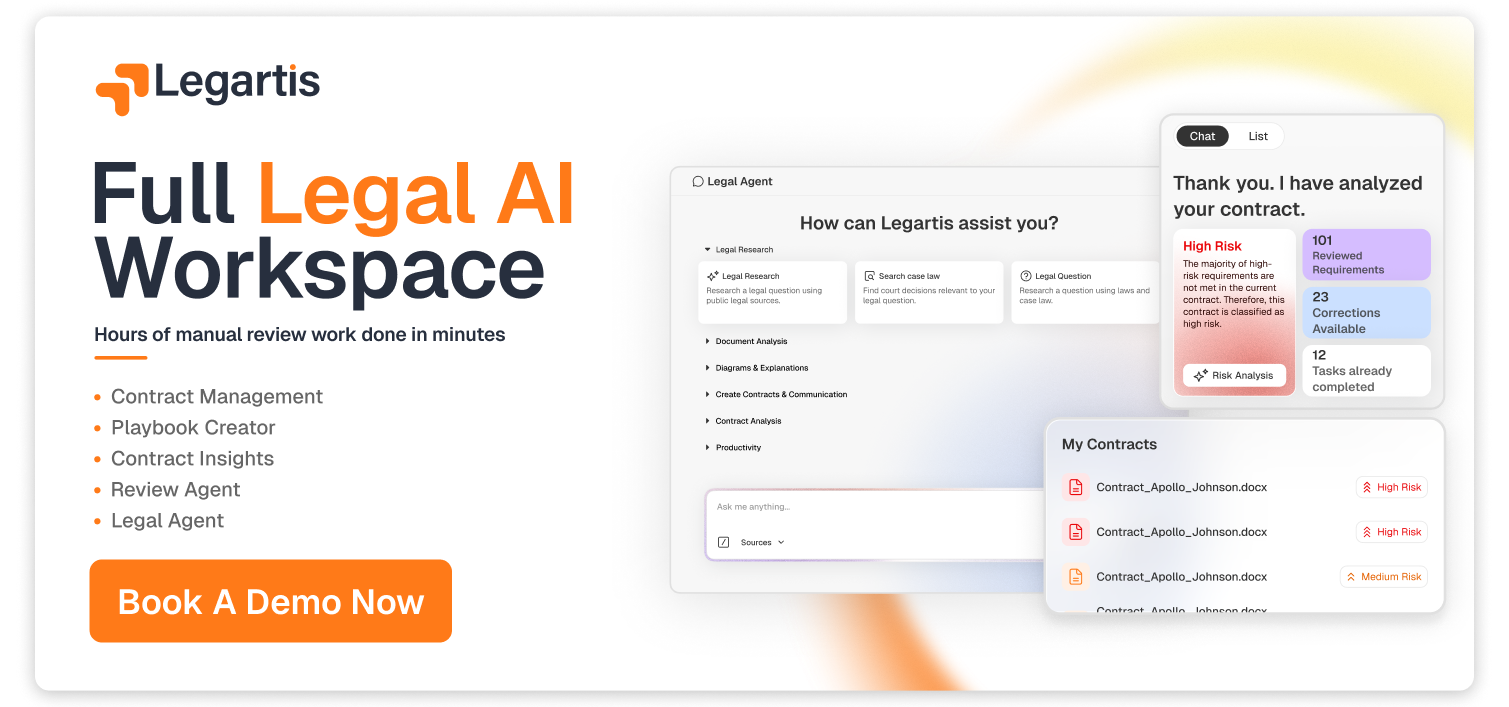
If your legal team is dealing with too many contracts and not enough time to review them properly, book a demo with Legartis. It's an AI contract review software platform that cuts a 60-minute manual review down to under 10 minutes.
AI contract review automation for legal teams is not a chatbot you ask questions to. It's a system that reads a contract, compares every clause against a predefined set of standards, and surfaces anything that doesn't match — before a human has to go looking for it.
Manual review of a standard data protection agreement takes an experienced lawyer 45 to 60 minutes. With AI, that same initial review takes under 10 minutes. And because the AI applies the same logic to every contract it sees, you get consistency that a manual process simply can't produce at volume.
The Playbook: The Foundation of AI Review
The foundation of how AI review works is something called a playbook. A playbook is your company's internal rulebook for contracts — covering the preferred clauses, the fallback positions if a counterparty pushes back, and the rules for what goes to a senior lawyer versus what gets approved automatically.
Without a playbook, AI just produces a summary. It tells you what's in the contract, but it can't tell you whether what's in the contract is acceptable by your standards.
With a playbook, the AI checks every incoming contract against your specific positions and surfaces deviations — which means reviewers spend their time on actual decisions rather than reading through documents looking for problems.
What AI Accuracy Actually Means
This is the question I hear most from legal teams evaluating AI contract review software, and it's almost always framed wrong. Buyers expect a single number — 87%, 92%, whatever. That number exists, but quality in Legal AI isn't a number. It's a system of reinforcing layers, where each one reduces a different kind of risk.
The foundation is your playbook — your company's standards, in a structure the AI can actually apply. Most tools stop here. On top of that sits calibration: the AI learns how your team thinks through a feedback loop during normal reviews, and through targeted tuning on the specific examples that matter most. That's the layer that closes the gap between generic AI output and your team's actual judgment. And above that, anomaly detection — flagging clauses that fall outside expected patterns, catching what your playbook didn't know to look for.
No single layer is enough. Together they make AI review auditable, explainable, and actually trustworthy in production. A black-box accuracy number can't deliver that. A multi-layered quality system can.
AI Doesn't Replace the Human Layer — It Changes What It's For
AI handles the first pass — reading the document, comparing it against the playbook, and surfacing the issues that need attention. A lawyer or senior reviewer then focuses on interpretation and strategy, the parts that require judgment and relationship awareness.
Teams that implement this well see a 3 to 4x return on investment — not just from eliminating routine legal review, but from freeing lawyers up from repetitive reading so they can focus on work that actually requires their expertise.
How to Make Contract Review Efficient with Legartis
Step 1: Build Your Playbook
The first thing to get in place is your playbook. The reason most companies don't have one is that building it manually takes months — you're essentially translating every legal position your company has taken across years of negotiation into a structured set of written requirements, and doing that from scratch is a significant project.
With Legartis, playbook creation is automated through what we call the Playbook Agent. You either upload representative sample contracts or input your key requirements, and the agentic AI produces a complete playbook from that input — including the requirements, the fallback language, and a test set that validates quality before you use it.
Step 2: Run Reviews Directly in Microsoft Word
Once the playbook is in place, Legartis reviews contracts against it in seconds, directly inside Microsoft Word or through the workspace. You activate the add-in, the AI runs the review, and what comes back is a structured breakdown of every clause that deviates from your standards — with the specific issue and the suggested adjustment.
For a team processing hundreds of contracts a year, that changes what the review queue looks like. Instead of every contract requiring a full read, reviewers go straight to the issues the AI has already identified.
Step 3: Data Sovereignty and Multilingual Coverage
One thing that matters a great deal for European companies and multinationals is where contract data is processed. At Legartis, contract data is processed on infrastructure in Switzerland and is never shared with third parties like OpenAI or Google for training. For legal and procurement teams with GDPR obligations or data residency requirements, that's not a minor detail — it's a hard requirement, and it's one that many US-built tools on the market simply can't meet.
Legartis also works across all European languages, so the same system covers a multilingual contract portfolio without needing separate tools.
Step 4: Roll It Out Beyond Legal
The companies that get a real return on AI contract review automation for legal teams are the ones that extend the process beyond the legal department. Sales catches issues on incoming agreements before they ever reach legal — only the deals that actually need legal judgment get escalated. Procurement runs every vendor contract through the same playbook, so compliance is built into the process rather than checked after the fact. And legal gets to focus on what actually requires their expertise: negotiation, complex deals, strategy.
The Process Isn't the Problem. The Scale Is.
If you're running a legal or procurement team and contracts are taking longer to review than your business can afford, the process itself usually isn't what's broken. It's the volume the process was never designed to handle.
AI contract review doesn't change what good contract review is — it changes what's possible at scale. The same standards, applied consistently, across every contract, in a fraction of the time.
If you want to see how it works for your specific contract types, book a demo with Legartis. You'll get a live walkthrough so you can see exactly where you'll save time before you commit to anything.
David A. Bloch is the CEO of Legartis, an enterprise AI contract review software platform built for European legal teams.
Start withLegartis Today!
Talk to us about your business case or test Legartis right away!