
Intelligent Contract Solutions: Use Cases, Features and How to Evaluate Them (2026)
Table of contents
Intelligent contract solutions are systems that turn contracts from static documents into operational decision logic. Before you start a pilot, you need clear decision criteria.
Intelligent contract solutions are systems that turn contracts from static documents into operational decision logic—by extracting meaning from contract language, applying standards (policies/playbooks), and triggering workflows (approve, escalate, redline, track obligations, report). The difference between “smart” and truly “intelligent” is governed decision-making: consistent outcomes you can explain, measure, and audit.
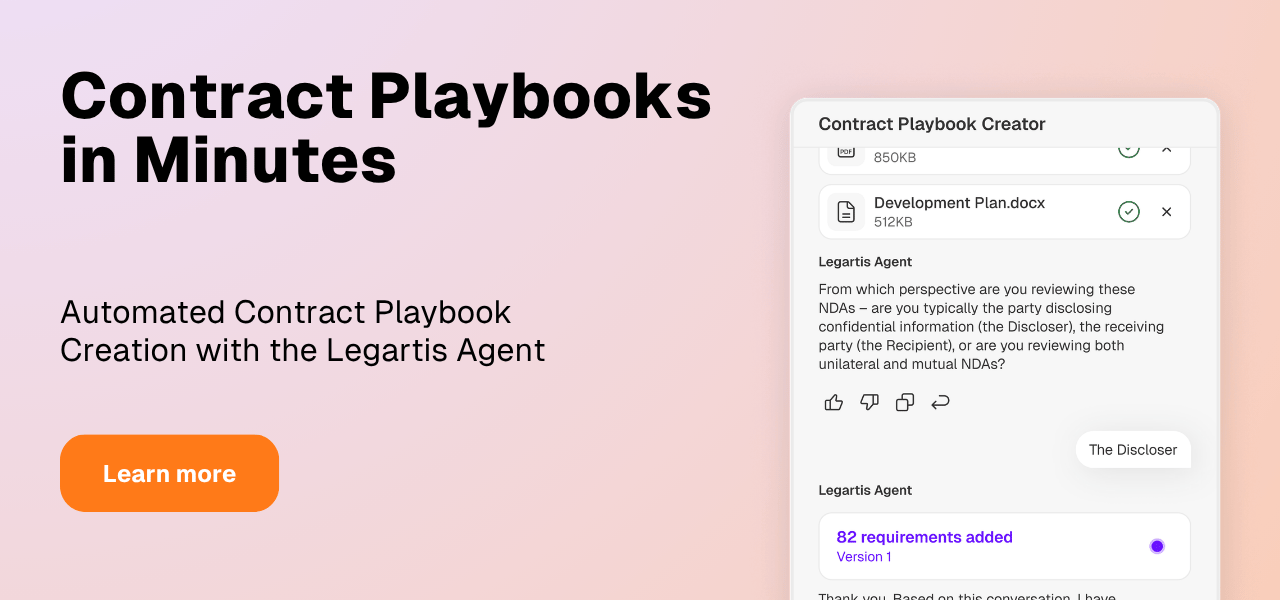
A practical example of a playbook-first approach is the Legartis Contract Playbook Creator, which converts contract standards into structured playbook logic and validates AI quality iteratively with transparent, controllable quality signals.
This article clarifies what the market means by “intelligent contract solutions,” shows how buyers realistically evaluate these systems (capabilities, governance, ROI), and ends with a checklist for pilot phases. The goal is not to list “AI features”—but to make decision criteria explicit.
Table of contents
1. What are “Intelligent Contract Solutions” (and what aren’t they)?
A term used for three different solution types
In many organizations, “intelligent contract solutions” is used as an umbrella term for AI-powered contract applications—even though it can describe very different software categories. Clarifying what you actually need upfront avoids mismatched expectations later, especially during vendor pilot phases.
In practice, “intelligent contract solutions” typically refers to one of these three categories:
- CLM platforms with AI (end-to-end contracting + AI features)
- Contract intelligence tools (extract, classify, benchmark, summarize, score)
- Playbook-driven contract review solutions (review contracts against rules and receive correction suggestions)
When someone on the Legal team says “we need an intelligent contract solution,” the fastest clarifying question is: What should the system actually do? Manage the lifecycle, extract/analyze contract data—or enforce standards and decisions in contract review?
What it is not
This distinction matters because adjacent concepts are frequently lumped together—and that unnecessarily distorts tool selection.
- Not “smart contracts” (blockchain)—a different concept, a common confusion.
- Not just e-signature or storage—that digitizes execution, but not decisions.
- Not just summaries—these help with reading; but contract intelligence answers: what is the next action?
Once the category is clear, the next question becomes central: Which outcomes matter most—and who benefits first? Even when Legal drives the initiative, measurable effects typically show up across teams (cycle times, escalations, risk control, predictability).
2. Intelligent Contract Solutions for Different Teams
Finance Teams
The Finance perspective forces measurability: where do contracts affect revenue timing, audit exposure, and financial risk—not just legal correctness?
- Typical pain: Delayed revenue recognition, risk exposure, audit pressure.
- What “intelligent” means: Contract scoring, structured extraction of revenue/termination clauses, consistent risk tagging, audit-ready evidence trails.
RevOps Teams
RevOps experiences contracting as pipeline friction. The focus is on visibility, exceptions, and clean handoffs—so deals move through more predictably.
- Typical pain: Deals stuck in legal review, poor visibility into exceptions, pipeline delays.
- What “intelligent” means: Exception routing, standard fallback positions, cycle time analytics, cross-team alignment.
Marketing Teams
Marketing becomes relevant when it accelerates the buying process in enterprise accounts by building trust and delivering clear standards. When contract terms, security/privacy information, and claims are consistently aligned, procurement and IT security raise fewer questions—and decisions happen faster.
- Typical pain: Building trust, maintaining consistent messaging, reducing friction in enterprise review processes.
- What “intelligent” means: Trust signals, consistent terms, faster alignment with procurement and information security.
Legal Teams
Legal is usually the hub: The challenge is not only to review more contracts faster, but above all to ensure that different reviewers reach the same conclusions—and that exceptions can be explained clearly and defended when needed.
- Typical pain: Growing contract volume, repeated low-risk reviews, inconsistent decisions across reviewers.
- What “intelligent” means: Consistently enforce review standards (playbooks), detect deviations, apply clear escalation rules, measure quality, document decisions end-to-end (audit trail).
Procurement Teams
Procurement brings the scale perspective: Many small deviations in vendor terms add up over time to more risk and higher costs. “Intelligent” here means: detect deviations quickly and consistently—and route them for structured follow-up.
- Typical pain: High volume of vendor term deviations, hidden liability risks, slow approvals.
- What “intelligent” means: Benchmark vendor terms, highlight deviations, route exceptions, systematically track obligations and renewals.
Across all teams: results are only truly valuable when you can translate them into concrete capabilities that are measurable and demonstrable in a pilot. That’s exactly what the next chapter covers.
3. Core Capabilities: What Separates “Intelligent” from “Basic”
Almost every vendor can show impressive results in a demo. What matters is whether those results hold up under real conditions—with real documents, real deviations, real edge cases. The following overview is a pragmatic maturity model. If a vendor can’t demonstrate these in a pilot, “intelligent” is usually just a label.
Capability | What “intelligent” means | Why it matters
1. Document ingestion | PDF/Word/email import + metadata capture | Removes manual prep
2. Clause & data extraction | High precision + traceable to the text | Prevents silent errors
3. Contextual risk detection | Not keyword-only; understands meaning | Reduces missed issues
4. Playbook/standard enforcement | Rules tied to policy + fallback logic | Ensures consistent decisions
5. Redline suggestions | Changes aligned to playbook positions | Speeds up negotiation
6. Workflow automation | Approvals, routing, escalations, SLAs | Removes bottlenecks
7. Obligation management | Track duties, dates, renewals | Prevents leakage
8. Analytics | Cycle time, deviations, clause KPIs | Enables governance
9. Security & compliance | SSO, access controls, data residency options | Enables enterprise adoption
10. Quality controls | Test sets, scoring, audit trails | Prevents false confidence
Interpretation note: Capabilities 1–9 determine whether the tool is useful in practice. Capability 10 matters when you want to trust the tool at scale. That’s why the next section focuses on playbooks and the “intelligence layer”—the point where understanding becomes binding, enforceable decisions.
4. Playbook Automation: From Standards to Decisions (the “intelligence layer”)
The core idea is simple: contracts only become truly operationally useful when standards are explicitly defined and consistently enforceable. That’s exactly what playbooks are for: they translate standards into clear rules that can be applied uniformly—regardless of who reviews, in which region, and for which contract type.
A contract playbook is your organization’s internal rulebook: preferred clauses, fallback positions, escalation paths, and clear deal breakers.
The Legartis Contract Playbook Creator shows how an agentic playbook solution can analyze existing contracts to standardize clauses, suggest fallback positions, and embed escalation logic directly into playbook creation.
Why playbooks determine how useful AI is for contract review
Many disappointments with contract review AI stem from assuming AI solves everything on its own. But as long as standards remain implicit—in individual reviewers’ heads—AI output may look plausible while producing inconsistent decisions and new risks in practice.
Without a playbook (or equivalent explicit, encoded standards), AI in contract review typically produces:
- Inconsistent risk ratings, because evaluation criteria aren’t clearly defined,
- Redline suggestions that contradict your negotiating position,
- Excessive output text that actually increases review time, because everything still needs to be checked manually.
Intelligent playbooks as an emerging market pattern
To close this gap, the market is shifting: playbooks are no longer seen as static PDFs, but as a bridge between standards and execution. This makes them usable beyond Legal—through guided reviews and scalable enforcement of standards across all business units.
Intelligent Contract Solutions — Lifecycle + Decision Layer
Contract lifecycle
Draft
↓
Review
↓
Negotiate
↓
Sign
↓
Manage
Intelligence layer
• Extract clauses & obligations
• Apply playbook rules (preferred + fallback)
• Trigger workflows (approve / escalate / redline)
• Quality controls (tests, scoring, audit trail)
• Analytics (cycle time, deviations, KPIs)
• Security & governance (roles, data residency, retention)
Where Legartis fits in this framework
A playbook-first approach aims to define standards so that clear, repeatable review decisions emerge—rather than leaving the critical step to gut feel after an AI summary.
Agentic Legal AI solutions like the Legartis Contract Playbook Creator operationalize standards into a system of requirements, fallback positions, and escalation logic—so reviews scale consistently, regardless of person, team, or contract type. And AI for contract review by Legartis is a good example of how playbooks guide review outcomes for Legal, Sales, and Procurement teams.
Once playbooks become the decision layer, trust becomes the bottleneck: when a system is confidently wrong, automation doesn’t reduce risk—it multiplies it. That’s why the following governance and control mechanisms are absolutely critical.
5. Quality & Governance: How to Avoid False Confidence
Must-have controls (non-negotiable)
Confidence thresholds + safe fallbacks
What happens under uncertainty? If a system outputs definitive decisions despite uncertainty, risk increases dramatically.
Test sets and measurable performance
Without tests using representative contracts and without measurable performance metrics, you cannot manage risk.
Audit trail (traceability)
The system must be able to demonstrate which text was recognized, which rule was applied, why escalation occurred, and exactly what was changed.
Playbook governance
Clear accountability, change logs, and fixed review cycles—otherwise you’re scaling outdated standards.
A concrete example of these control mechanisms is described in the article “Legartis launches the Contract Playbook Creator”. There, automated playbook creation is combined with iterative verification using test sets and a transparent quality score.
6. ROI Drivers: Where Savings and Risk Reduction Actually Come From
Avoid vague ROI promises. Tie outcomes to measurable changes:
- Cycle time: From days to hours
Faster routing, fewer review loops, less back-and-forth. - Reviewer capacity: More contracts per FTE
Legal can focus on exceptions and high-risk clauses. - Deviation rate: Fewer non-standard clauses accepted
Real risk reduction comes from consistent standards enforcement. - Obligation compliance: Fewer missed deadlines and renewals
Especially relevant for purchase, SaaS, and regulated contracts. - Negotiating strength: Clear standard and fallback positions
Strong playbooks reduce creeping concessions.
A simple reality check: ask where you actually save time in day-to-day work. If every AI output still requires extensive manual verification, the work hasn’t disappeared—it’s just shifted from reading to checking.
That’s why decision logic is the real differentiator and helps avoid time traps. Standard cases should be approved quickly and transparently. Deviations are either escalated to the right owner—based on clearly defined thresholds—or directly addressed with appropriate redline suggestions.
This is exactly how playbook automation is positioned as a lever to enable contract review across all contract types while reducing the burden on the legal team.
Playbook-driven contract review — Decision flow
1) Ingest contract (PDF / Word)
↓
2) Extract clauses + context
↓
3) Match against playbook rules
↓
Decision
OK → approve / fast-track
No material deviations detected
↓
Deviation → redline / escalate
Route to owner based on thresholds
Note: “Intelligent” requires quality controls (confidence thresholds, test sets, audit trail).
Now that the decision logic and ROI levers are clear, vendor evaluation becomes much simpler. The next section is a copy/paste toolkit you can use to qualify vendors quickly and set up a clean pilot.
7. Buyer’s Checklist + Evaluation Scorecard
10 Questions for Quick Pre-Qualification
- Which contract types are supported out of the box?
- Can the system enforce a playbook during contract review, rather than just providing a PDF for manual reference?
- How is quality measured (tests, scoring, audit trails)?
- What happens at low confidence: does it escalate or “guess”?
- Can fallback positions vary by region/entity/business unit?
- PDF vs. Word: how large is the difference in functionality?
- Integrations: CLM, CRM, DMS, e-sign, email?
- Security: SSO, roles, encryption, data residency, retention?
- Time to value: how long does a pilot take, and what counts as “done”?
- Pricing: is the price predictable at scale?
Evaluation Scorecard
Criteria | Weight | What to look for
Playbook enforcement | 20% | Automated deviation checks, routing, redline suggestions
Quality controls | 20% | Test sets, scoring, auditability/traceability
Accuracy & coverage | 15% | Contract types, languages, formats
Workflow fit | 15% | Word-first, platform-agnostic, CLM integration
Security & compliance | 15% | SSO, encryption, data residency options
Analytics | 10% | Deviations, cycle time, KPIs
Total cost | 5% | Licensing + implementation
Want to see live how this works in practice? From highly standardized playbook enforcement to measurable quality controls and auditable decision trails? Book a demo with Legartis and we’ll walk through real examples against your standards.
Pilot Success Metrics (for your kickoff)
- Median contract review cycle time
- Share of contracts: fast-track vs. escalation
- Quality of deviation detection: sample plus audit trail
- Reviewer time saved: self-assessment plus measurement
- Completeness of obligation capture: deadlines, renewals, duties
Selection is only half the work. The other half is disciplined rollout. The next section outlines a practical 90-day path: start narrow, validate quality, then scale gradually.
8. Implementation Blueprint: A Realistic 90-Day Path
Days 1–14: Define scope and standards
- Choose one contract type: NDA or a common MSA template.
- Set “golden rules” in the playbook: preferred position, fallback position, deal breaker (red line).
- Define escalation thresholds: who can approve what—and when must it escalate?
Days 15–45: Run pilot and ensure quality
- Load a representative set: current contracts, different counterparties, typical exceptions.
- Run a direct comparison: manual review vs. system output.
- Systematically capture error types: false positives, false negatives, ambiguities.
- Set confidence thresholds and safety nets: when is “confident enough,” and what happens under uncertainty?
Days 46–90: Integrate workflow and roll out
- Integrate into daily work: e.g., via Word add-in and/or CLM.
- Train reviewers on exceptions: focus on judgment and escalation—not “button-pushing.”
- Establish playbook governance: clear owners, change log, monthly review cycle.
---
Want to see what governed contract intelligence looks like in practice—with playbooks, clear quality checks, and a traceable audit trail? Book a demo with Legartis. We’ll walk you through concrete examples against your standards.
---
9. Frequently Asked Questions
What are intelligent contract solutions?
Intelligent contract solutions are systems that not only analyze contracts but derive traceable decisions from them: they identify relevant clauses, apply your standards (policies/playbooks), and trigger defined steps—such as approval, escalation, redline suggestions, obligation tracking, or reporting.
How is this different from CLM (Contract Lifecycle Management)?
CLM manages the contract lifecycle (drafting, negotiation, signing, storage). Intelligent contract solutions go further: they implement standards in review as decision logic and automate resulting actions (e.g., fast-track vs. escalation)—ideally including quality measurement and auditability.
Do we need a playbook first?
You need clear, explicit standards—a playbook is the most practical form for this. It defines preferred positions, acceptable deviations (fallbacks), and escalation rules. Without such rules, a system can analyze text but cannot make consistent, controllable decisions.
What is the biggest risk with AI contract review?
The biggest risk is false confidence: results look plausible but are wrong or incomplete on critical points. That’s why safety mechanisms are central: clear uncertainty thresholds, escalation instead of “guessing,” tests with representative contracts, and an audit trail that traces every decision back to text and rules.
What should we definitely measure in a pilot?
Measure review cycle time, the share of auto-approved cases (fast-track) vs. escalations, the quality of deviation detection (with traceable reasoning), actual reviewer time saved, and completeness of obligation capture (deadlines, renewals, duties).
How long does a typical playbook run take from upload to approval?
It depends on contract type, document quality (Word vs. PDF), number of rules, and escalation paths. In a well-defined setup, standard cases can be reviewed and approved in minutes; deviations take longer because they trigger redlines, clarifications, or escalations. What matters is that the process has clear thresholds and accountability so exceptions don’t get stuck in the system.
Explore Related Insights
More articles related to this topic

Intelligent Contract Management: How Inhouse Teams Manage Contracts Predictably

How to Create a Contract Playbook in 5 Steps

Contract Reviews with ChatGPT? Chances, Risks, Alternatives
Start withLegartis Today!
Talk to us about your business case or test Legartis right away!